

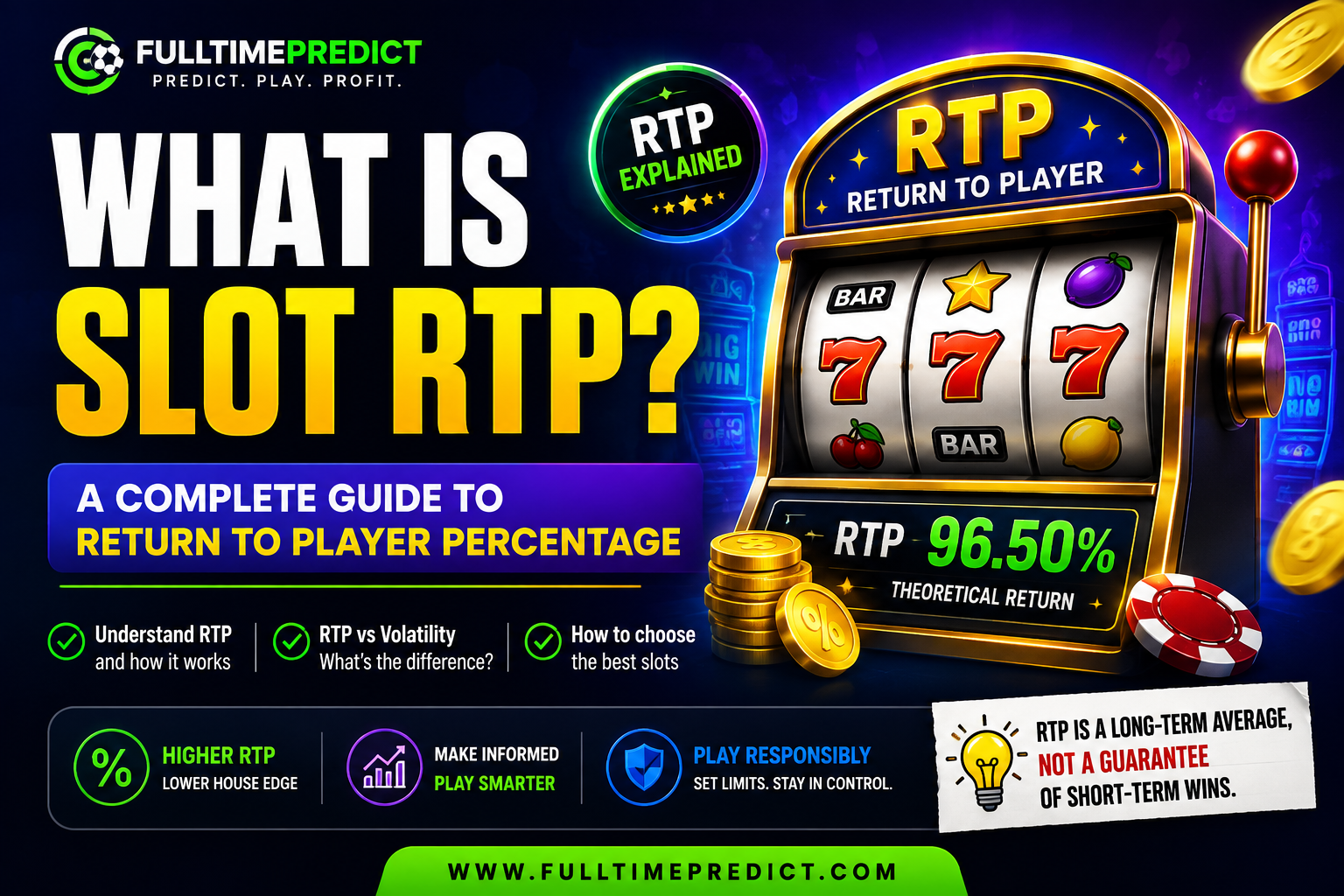
If you have ever played or researched an online slot, you may have seen a percentage such as 96% RTP or 94% RTP in the game’s information section.
But what does it actually mean?
RTP stands for Return to Player. It is a percentage that represents the theoretical proportion of money wagered on a game that is designed to be returned to players over a very large number of spins.
For example, a slot with a 96% RTP is theoretically designed to return £96 for every £100 wagered across a very large sample of gameplay. The remaining 4% represents the game’s theoretical house edge.
The most important thing to understand, however, is this:
A 96% RTP does not mean you will personally receive £96 back every time you wager £100.
RTP is a long-term mathematical average. Individual sessions can produce results that are significantly above or below the theoretical RTP because slot outcomes are random and can vary considerably in the short term.
This guide explains everything you need to know about slot RTP, including how RTP works, how it is calculated, RTP versus volatility, and what players should look for when comparing online slots.
What Does RTP Mean in Slots?
RTP means Return to Player.
It is expressed as a percentage and represents the theoretical amount of total wagers that a game is designed to return to players over the long run.
Here is a simple example:
| Slot RTP | Theoretical Return | House Edge |
|---|---|---|
| 98% | £98 per £100 wagered | 2% |
| 96% | £96 per £100 wagered | 4% |
| 95% | £95 per £100 wagered | 5% |
| 94% | £94 per £100 wagered | 6% |
These figures describe the game’s theoretical long-term mathematical model—not what any individual player should expect to receive during a particular session.
A game with a 96% RTP could produce a large win during one session and a significant loss during another. Both outcomes can occur because individual spins are subject to randomness and natural volatility.
The UK Gambling Commission explains that RTP is an average measured over a significant number of games and should not be interpreted as a guaranteed return from an individual playing session.
How Does Slot RTP Work?
Every slot game is built around a mathematical model.
The game’s:
- Symbols
- Paytable
- Winning combinations
- Bonus features
- Probability structure
- Jackpot mechanics
all contribute to the game’s theoretical return.
The RTP percentage represents the long-term relationship between the total amount wagered and the total amount returned as winnings.
For example:
Imagine that players collectively wager £1,000,000 on a 96% RTP slot.
Over a sufficiently large number of spins, the theoretical mathematical model would target approximately:
- £960,000 returned to players collectively
- £40,000 representing the theoretical house edge
This does not mean that every player receives exactly 96% of their money back.
Some players may win significantly more than they wager.
Others may lose their entire stake.
The RTP is based on the game’s performance across an extremely large amount of gameplay rather than the result of one person playing for a few minutes or hours.
Is a Higher RTP Better?
From a purely mathematical perspective, a higher RTP means a lower theoretical house edge.
For example:
96% RTP
The theoretical house edge is:
100% − 96% = 4%
94% RTP
The theoretical house edge is:
100% − 94% = 6%
Therefore, when comparing two games with otherwise similar characteristics, the higher RTP has the lower theoretical house advantage.
However, RTP should not be the only factor used when comparing slot games.
Players should also consider:
- Slot volatility
- Maximum win potential
- Bonus features
- Betting limits
- Game mechanics
- Personal entertainment preferences
A higher RTP does not guarantee a better result during an individual session.
What Is Considered a Good Slot RTP?
There is no universal RTP percentage that guarantees whether a slot is “good” or “bad.”
RTPs vary between games, providers and sometimes different versions or configurations of the same game.
However, many players use the following ranges as a general comparison tool:
| RTP Range | General Interpretation |
|---|---|
| 97% and above | Very high theoretical RTP |
| 96%–96.99% | High RTP |
| 95%–95.99% | Moderate-to-high RTP |
| 94%–94.99% | Lower theoretical return |
| Below 94% | Relatively low RTP |
These ranges are comparison guidelines rather than predictions of future results.
The key principle is:
Higher RTP means a higher theoretical long-term return, but it does not tell you what will happen during your next session.
RTP vs House Edge: What Is the Difference?
RTP and house edge are closely connected.
They represent opposite sides of the same mathematical calculation.
RTP Formula
RTP + House Edge = 100%
For example:
96% RTP
- Player return: 96%
- House edge: 4%
95% RTP
- Player return: 95%
- House edge: 5%
98% RTP
- Player return: 98%
- House edge: 2%
The house edge represents the theoretical advantage built into the game over the long term.
This is why players researching casino games often compare RTP percentages before choosing which games to play.
RTP Does Not Predict Your Next Spin
This is one of the biggest misunderstandings about slot RTP.
A player may see a 96% RTP slot and think:
“If I play long enough, I will eventually get 96% of my money back.”
That is not how RTP works.
Slot results are not designed to gradually correct an individual player’s results until they reach the theoretical RTP.
For example, if you wager £100 on a slot with a 96% RTP, you could:
- Win £500
- Win £100
- Win £50
- Lose £100
Any of these outcomes may occur during an individual session.
The RTP percentage becomes more meaningful across an extremely large number of plays.
Random games can vary substantially from their theoretical average over short periods of play.
Slot RTP vs Slot Volatility
RTP and volatility are not the same thing.
This is one of the most important concepts to understand when comparing online slots.
RTP answers:
How much does the game theoretically return over the long term?
Volatility answers:
How can wins and losses be distributed during gameplay?
A slot can have:
- High RTP and high volatility
- High RTP and low volatility
- Lower RTP and high volatility
- Lower RTP and low volatility
Therefore, a high RTP does not automatically mean that a game will provide frequent wins.
Example
Imagine two hypothetical slots:
Slot A
- RTP: 96%
- Low volatility
It may theoretically produce more frequent but smaller wins.
Slot B
- RTP: 96%
- High volatility
It may theoretically produce longer periods without significant wins but potentially larger winning outcomes.
Both games can have the same theoretical RTP while producing very different playing experiences.
The UK Gambling Commission notes that RTP is a long-term average and that actual results can vary during typical sessions because of game volatility.
What Is the Difference Between RTP and Hit Frequency?
Another commonly misunderstood term is hit frequency.
Hit frequency refers to how often a slot produces any type of winning combination.
For example:
A hypothetical 30% hit frequency
This could mean that approximately 30 out of every 100 spins produce some form of winning outcome.
However, that does not tell you:
- How large the wins will be
- Whether the wins are profitable after the stake
- How much the game returns overall
A slot can have:
- A high hit frequency with small wins
- A lower hit frequency with larger potential wins
RTP, volatility and hit frequency all describe different aspects of a game’s mathematical structure.
How Is Slot RTP Calculated?
RTP is based on the mathematical probabilities and payouts programmed into a game.
The calculation considers factors such as:
- Probability of each possible outcome
- Value of each potential payout
- Frequency of winning combinations
- Bonus round mechanics
- Jackpot contributions
In simplified terms, the theoretical return is determined by comparing expected payouts against total wagers across a very large number of plays.
The UK Gambling Commission explains that actual RTP can be calculated using the relationship between win figures and turnover generated by a game.
For players, the important point is that RTP is a mathematical long-term statistic, not a prediction tool.
Why Can the Same Slot Have Different RTP Versions?
In some cases, a game can be offered with different RTP configurations.
This means that seeing the name of a slot game alone may not always be enough to know the exact RTP available at a particular casino.
For that reason, players should check the RTP information within the actual version of the game they are playing.
A good place to look is usually the:
- Game information screen
- Help section
- Paytable
- Rules section
- Information icon
Do not assume that every version of a particular slot has exactly the same RTP.
How to Check the RTP of an Online Slot
Checking slot RTP is usually straightforward.
Step 1: Open the slot game
Launch the game you are interested in.
Step 2: Look for the information icon
This may appear as:
- i
- ?
- Menu icon
- Help
- Game Rules
Step 3: Open the paytable or rules section
Look for information about:
- RTP
- Return to Player
- Game RTP
- Theoretical RTP
Step 4: Check the percentage
You may see something such as:
Theoretical RTP: 96.10%
That percentage represents the game’s stated long-term theoretical return.
Where gambling products are regulated, operators and manufacturers may also have requirements relating to testing, fairness and RTP information. The UK Gambling Commission states that online gambling products must be tested in line with its requirements and that operators must monitor game performance to help ensure games operate as designed.
Does RTP Affect Your Chances of Winning?
RTP affects the game’s theoretical mathematical return over the long term.
However, it does not predict whether you will win on your next spin.
For example:
A 97% RTP slot does not guarantee that you will perform better during a 50-spin session than someone playing a 94% RTP slot.
Short-term results can vary significantly.
This is because RTP is only one part of the mathematical structure of a slot.
Other important factors include:
- Randomness
- Volatility
- Hit frequency
- Stake size
- Bonus features
- Session length
The safest way to think about RTP is:
RTP helps you compare the long-term mathematical characteristics of games, but it cannot predict the result of an individual session.
Does a High RTP Slot Guarantee a Profit?
No.
A high RTP slot does not guarantee profit.
This is an important distinction.
Consider a hypothetical 97% RTP game.
That does not mean:
Bet £100 → Receive exactly £97.
The actual result of an individual session could be higher or lower.
You could:
- Win significantly more than your original stake
- Lose a small amount
- Lose your entire bankroll
The RTP percentage only describes the theoretical average performance across a very large amount of gameplay.
There is always risk involved in gambling, and players should only gamble with money they can afford to lose.
Is RTP More Important Than Volatility?
Neither statistic is universally more important.
They provide different information.
Choose RTP information when you want to understand:
- Theoretical long-term return
- Theoretical house edge
- How one game’s mathematical return compares with another
Consider volatility when you want to understand:
- How uneven the gameplay may be
- Whether wins may be more frequent or less frequent
- Whether the game may involve larger swings
The best approach is to look at both.
For example:
| Factor | What It Tells You |
|---|---|
| RTP | Theoretical long-term return |
| House Edge | Theoretical casino advantage |
| Volatility | Potential size and frequency patterns of wins/losses |
| Hit Frequency | How often winning outcomes may occur |
| Max Win | Maximum theoretical payout potential |
Looking at several statistics gives you a better understanding of a slot than relying on one number alone.
Common Myths About Slot RTP
Myth 1: A 96% RTP means I will get £96 back from £100
False.
The percentage applies to long-term theoretical gameplay across a large number of wagers.
Myth 2: The slot owes me a win
False.
Previous results do not necessarily mean that a random game is “due” to pay a particular player.
Myth 3: A higher RTP guarantees a winning session
False.
A higher RTP represents a better theoretical long-term return but cannot predict an individual session.
Myth 4: RTP and volatility are the same
False.
RTP describes theoretical long-term return, while volatility relates to how outcomes may vary during gameplay.
Myth 5: You can beat the RTP by playing longer
Not necessarily.
Playing longer does not guarantee that your personal results will move toward the theoretical RTP.
More gameplay also means more money is exposed to the game’s house edge.
How to Use RTP When Choosing an Online Slot
RTP should be used as a comparison tool rather than a winning strategy.
Here is a practical approach.
1. Check the game’s RTP
Compare the stated RTP with other games you are considering.
2. Check the volatility
A high RTP game can still have high volatility.
3. Understand the game’s features
Consider:
- Bonus rounds
- Free spins
- Multipliers
- Jackpot mechanics
- Maximum win potential
4. Set a budget
Decide in advance how much you are prepared to spend.
5. Never treat RTP as a guarantee
RTP describes long-term mathematics—not short-term results.
Why RTP Matters for Online Slot Players
Understanding RTP can help players become better informed about how slot games work.
Instead of choosing a game based only on:
- Graphics
- Theme
- Jackpots
- Advertising
players can also consider the mathematical information provided by the game.
RTP is particularly useful when comparing games with similar themes or mechanics.
For example, if two games offer a similar experience but one has a significantly higher theoretical RTP, that information may be relevant when deciding which game to play.
However, gambling should always be treated as entertainment rather than a guaranteed way to make money.
Slot RTP: Key Takeaways
Here are the most important things to remember:
- RTP stands for Return to Player.
- RTP is expressed as a percentage.
- A 96% RTP represents a theoretical £96 return for every £100 wagered across a very large amount of gameplay.
- RTP does not guarantee your personal result.
- Individual sessions can perform above or below the theoretical RTP.
- Higher RTP generally means a lower theoretical house edge.
- RTP and volatility measure different aspects of a slot.
- The same game may sometimes be available in different RTP configurations.
- Always check the RTP information in the specific game version you are playing.
- RTP should be used as a comparison tool—not as a prediction of winnings.
Learn More About Online Slots
Learn more about Slot Volatility and discover why two slots with the same RTP can produce very different playing experiences.
Discover what makes a good RTP in online slots, how high RTP slots work, and why RTP and volatility should both influence your slot selection.
Frequently Asked Questions About Slot RTP
What does RTP mean in slots?
RTP means Return to Player. It is the theoretical percentage of total money wagered on a slot that is designed to be returned to players over the long term.
Is 96% RTP good?
A 96% RTP generally represents a lower theoretical house edge than games with lower RTP percentages. However, it does not guarantee a profitable individual session.
Does higher RTP mean you win more?
Not necessarily during an individual session. Higher RTP represents a higher theoretical long-term return, but short-term results can vary significantly.
What is the difference between RTP and volatility?
RTP describes the theoretical long-term return of a slot. Volatility describes how wins and losses may be distributed during gameplay.
Can RTP predict the next winning spin?
No. RTP does not predict the result of your next spin or guarantee when a game will produce a winning outcome.
How do I find a slot’s RTP?
Check the game’s information, rules, help screen or paytable. The RTP may be listed as “Return to Player” or “Theoretical RTP.”
Is RTP guaranteed?
RTP is a theoretical mathematical figure based on long-term gameplay. Individual results can vary substantially and are not guaranteed to match the stated RTP during a particular session.
Final Thoughts: Is Slot RTP Important?
Yes, slot RTP is an important statistic—but it should not be misunderstood.
A higher RTP can indicate a better theoretical long-term return and a lower theoretical house edge. However, RTP cannot predict what will happen during your next session.
The best way to evaluate an online slot is to consider:
- RTP
- Volatility
- Hit frequency
- Game features
- Betting limits
- Your entertainment budget
Understanding these factors can help you make more informed choices, but no RTP percentage removes the risk involved in gambling.
Always gamble responsibly and never wager more than you can afford to lose.

Comments are closed.