

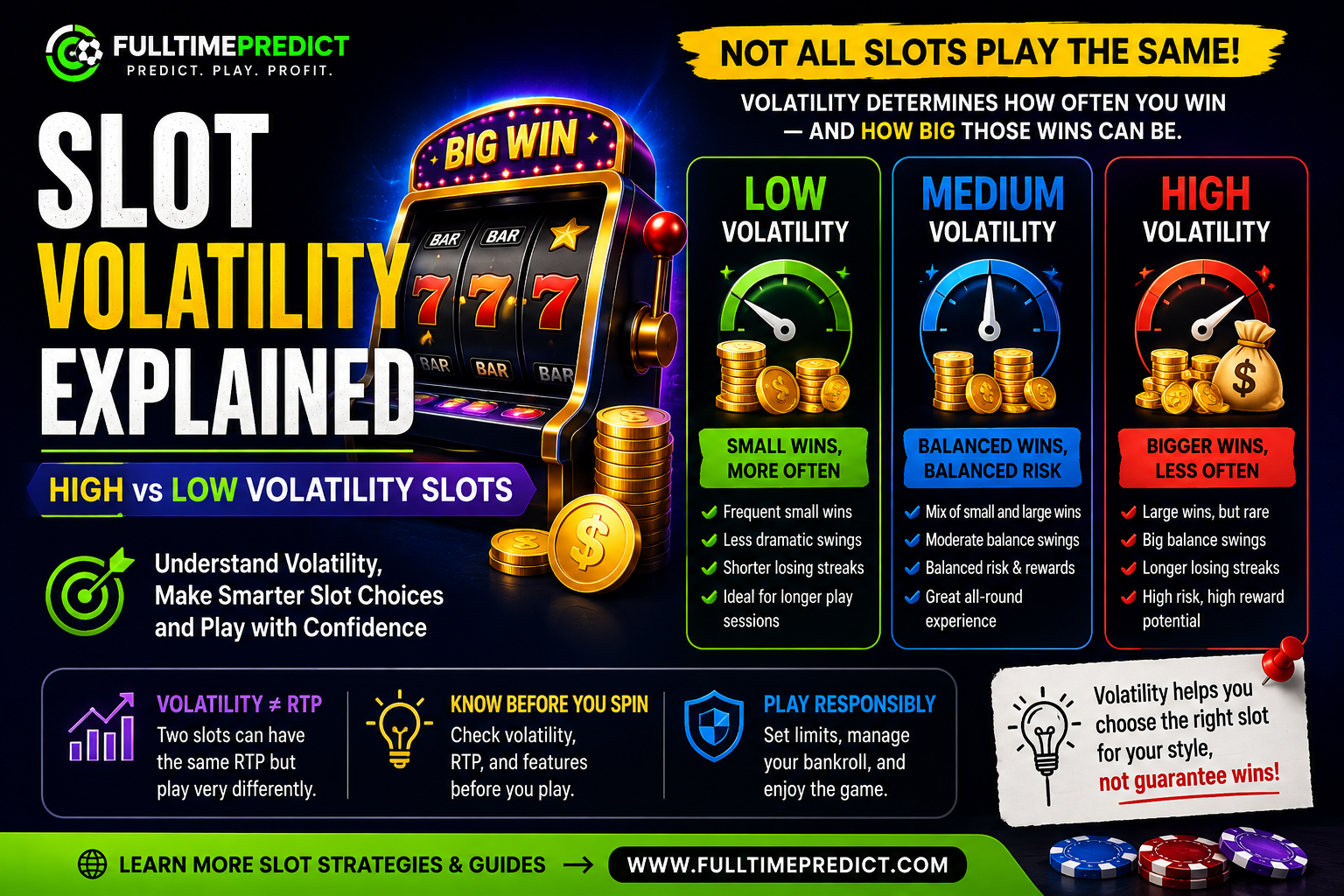
When choosing an online slot, one of the most important terms you may encounter is slot volatility.
Volatility can significantly affect how a slot feels during gameplay. Some slots may produce relatively frequent smaller wins, while others may have longer periods without substantial returns but offer the possibility of much larger individual prizes.
This difference is commonly described as slot volatility, also known as slot variance.
Understanding volatility can help players compare games more effectively, especially when combined with other information such as Return to Player (RTP), hit frequency, bonus mechanics and maximum win potential.
However, one important point should be clear from the beginning:
Slot volatility does not predict whether you will win or lose during an individual session.
Instead, it describes how the game’s prizes and returns may be distributed statistically over time.
This guide explains everything you need to know about high, medium and low volatility slots, how volatility differs from RTP, and how to use volatility information when comparing online slot games.
What Is Slot Volatility?
Slot volatility describes the variation in the size and frequency of outcomes produced by a slot game.
In simple terms, it helps explain whether a game’s mathematical structure tends to produce:
- Smaller wins more frequently
- Larger wins less frequently
- A balance between the two
Volatility is commonly associated with the distribution of prizes.
The UK Gambling Commission describes a highly volatile game as one that may include prizes in the “very large but rare” category, while a low-volatility game is more predictable and may consist mainly of “small and often” prizes.
This means that two slot games can have exactly the same RTP while producing very different short-term experiences.
For example:
Slot A
- RTP: 96%
- Low volatility
Slot B
- RTP: 96%
- High volatility
Both games may have the same theoretical long-term return, but the pattern of wins and losses can be very different.
Slot Volatility vs RTP: What Is the Difference?
One of the most common mistakes made by new slot players is confusing RTP with volatility.
They are related to the mathematical design of a game, but they measure different things.
RTP answers:
How much does the game theoretically return over the long term?
Volatility answers:
How are wins and losses likely to be distributed during gameplay?
A slot with a 96% RTP has a theoretical long-term return of 96% across a sufficiently large amount of gameplay.
But volatility helps explain whether that theoretical return is likely to be distributed through:
- Frequent smaller prizes
- Less frequent larger prizes
- A combination of both
The UK Gambling Commission’s RTP monitoring guidance specifically notes that volatility affects the acceptable variation around a game’s theoretical RTP and defines high volatility as potentially involving large but rare prizes, compared with smaller and more frequent prizes in lower-volatility games.
Simple comparison:
| Feature | RTP | Volatility |
|---|---|---|
| Measures long-term return | Yes | No |
| Describes win distribution | No | Yes |
| Predicts the next spin | No | No |
| Can affect session swings | Indirectly | Yes |
| Helps compare games | Yes | Yes |
For a complete explanation of Return to Player, link internally here to your:
What Is RTP in Slots? A Complete Guide to Return to Player Percentage
What Are Low Volatility Slots?
Low volatility slots generally distribute their returns through relatively smaller and more frequent winning outcomes.
That does not mean that every spin will win.
It also does not mean that a player is guaranteed to lose less money.
Instead, low volatility generally refers to a game structure where outcomes may be less extreme compared with highly volatile games.
Typical characteristics of low volatility slots include:
- Smaller average winning outcomes
- More frequent winning combinations
- Less dramatic balance swings
- Lower short-term variance
- More predictable prize distribution
The Gambling Commission’s description of low volatility refers to games that are more predictable and may consist mainly of smaller, more frequent prizes.
Example of a hypothetical low volatility experience
Imagine a player making 100 spins.
A low volatility game might theoretically produce:
- Several small winning outcomes
- Occasional medium-sized wins
- Fewer extremely large wins
Again, this is only a general description of volatility.
Actual results remain random and unpredictable.
What Are High Volatility Slots?
High volatility slots are generally associated with greater variation between outcomes.
They may produce:
- Longer periods without significant wins
- Larger swings in a player’s balance
- Less frequent winning outcomes
- Greater potential for large individual prizes
The UK Gambling Commission describes highly volatile games as potentially containing prizes that are very large but rare.
This means that high volatility can create a very different playing experience.
A player could experience a series of losing spins before encountering a significant winning outcome.
However, this does not mean a high volatility slot is “due” to produce a large win after a losing streak.
Every random outcome remains unpredictable.
The Gambling Commission’s technical standards require random outcomes to be acceptably random and prohibit operators from adapting probabilities during play in ways that would make outcomes predictably compensate for previous results.
Low Volatility vs High Volatility Slots
The following table provides a general comparison.
| Feature | Low Volatility | High Volatility |
|---|---|---|
| Win pattern | Smaller, more frequent | Larger, less frequent |
| Balance swings | Usually less dramatic | Can be more dramatic |
| Losing streaks | May be shorter on average | Can be longer |
| Prize distribution | More evenly spread | More uneven |
| Large win potential | Often lower | Can be higher |
| Short-term risk | Generally lower | Generally higher |
It is important to remember that these are broad tendencies.
The exact behaviour of a slot depends on its mathematical model, paytable and individual game mechanics.
What Is Medium Volatility in Slots?
Medium volatility slots sit somewhere between low and high volatility.
They are designed to offer a balance between:
- Frequency of winning outcomes
- Size of potential prizes
- Short-term balance movement
A medium volatility slot may provide a mixture of:
- Smaller base-game wins
- Occasional larger wins
- Bonus features capable of increasing payouts
For many players, medium volatility games can provide a middle ground between frequent smaller outcomes and the larger swings associated with highly volatile slots.
However, medium volatility still does not guarantee a particular result during an individual session.
Does High Volatility Mean Higher Wins?
Not necessarily.
This is another common misunderstanding.
High volatility means that a game may have a more uneven distribution of prizes, including potentially large but rare outcomes.
It does not guarantee:
- Bigger wins for a particular player
- A jackpot during a session
- Profit
- A recovery after a losing streak
A high volatility slot can have a high maximum win potential, but the probability of achieving a particular large payout may be extremely low.
The Gambling Commission notes that volatility must be considered when evaluating how actual RTP can vary around a game’s theoretical RTP, particularly because large, rare prizes can create wider variation in shorter samples of gameplay.
Does Low Volatility Mean You Cannot Win Big?
No.
Low volatility does not necessarily mean that a slot has no large prizes.
It generally means that the game’s mathematical structure places greater emphasis on more frequent and less extreme outcomes.
Individual games can have different:
- Paytables
- Bonus rounds
- Multipliers
- Jackpot systems
- Maximum win limits
Therefore, volatility should be considered alongside the complete game information.
How Does Slot Volatility Affect Your Bankroll?
Volatility can have a significant effect on how quickly a player’s balance fluctuates.
High volatility
A highly volatile game may experience:
- Larger balance swings
- Longer periods without significant returns
- Faster bankroll depletion during an unlucky run
Low volatility
A lower volatility game may produce:
- More frequent small returns
- Smaller swings
- A more gradual movement in the balance
However, frequent winning outcomes do not automatically mean profitability.
A winning spin may return less than the amount wagered across previous or current gameplay.
For example, receiving a small payout after several losing spins does not necessarily mean the player is ahead overall.
For this reason, players should set a budget before gambling and avoid increasing stakes in an attempt to recover losses.
How to Find a Slot’s Volatility
Volatility information is often available through the game’s information section.
Look for:
- The information icon
- Game rules
- Paytable
- Help section
- Game statistics
Volatility may be described as:
- Low
- Medium
- High
Some game providers may use different labels or visual rating systems.
Because there is no universal presentation format for volatility, it is useful to check the game’s own information before relying on third-party descriptions.
For RTP, regulated games may provide player-facing information about the game’s theoretical return. UK Gambling Commission guidance also requires gambling products to be tested and monitored to help ensure they operate fairly and as designed.
Is Slot Volatility the Same as Slot Variance?
In many casino discussions, the terms volatility and variance are used interchangeably.
Both generally refer to the degree of variation in a game’s results.
However, technical descriptions can be more precise.
The Gambling Commission notes that volatility is commonly represented using the game’s standard deviation, which is mathematically related to variance.
For most players, however:
Slot volatility and slot variance are commonly used to describe whether outcomes are relatively steady or highly variable.
Can You Predict Slot Volatility from Previous Spins?
No.
Previous spins cannot reliably predict the next spin.
If a highly volatile slot has produced:
- 20 losing spins
- 50 losing spins
- 100 losing spins
this does not mean that a large win is guaranteed to arrive.
Online gambling games using RNG systems are designed so that outcomes are unpredictable. UK Gambling Commission standards require random number generation and game outcomes to be acceptably random and prohibit adaptive behaviour that changes outcome probabilities during play.
This is why ideas such as:
“The slot is due to pay.”
should not be treated as a reliable gambling strategy.
How Does Volatility Affect RTP?
Volatility does not change the advertised theoretical RTP by itself.
Instead, volatility can affect how widely actual results move around that theoretical figure, particularly over shorter periods of gameplay.
For example, a highly volatile game may experience more dramatic short-term deviations because large prizes occur less frequently.
A lower volatility game may produce results that are distributed more evenly.
The Gambling Commission explains that the acceptable tolerance around a theoretical RTP depends partly on volatility and becomes narrower as the volume of gameplay increases.
This is why two slots with identical RTP percentages can feel completely different during normal playing sessions.
Example: Two Slots With the Same RTP
Imagine two hypothetical slots.
Slot A
- RTP: 96%
- Low volatility
Possible characteristics:
- Smaller prizes
- More frequent returns
- Less dramatic swings
Slot B
- RTP: 96%
- High volatility
Possible characteristics:
- Longer losing periods
- Less frequent large prizes
- Bigger balance swings
Over a sufficiently large number of plays, both games could theoretically return similar proportions of total stakes according to their RTP.
But a single player could have completely different experiences on each game.
This is one of the main reasons why RTP alone does not provide a complete picture of a slot game.
What Is Hit Frequency and How Is It Different?
Another important slot term is hit frequency.
Hit frequency generally refers to how often a spin produces a winning outcome.
However, hit frequency does not tell you:
- How much the win will be
- Whether the win exceeds your stake
- How much you will receive overall
- Whether you will make a profit
A game can have:
High hit frequency
Many winning spins, but relatively small payouts.
Low hit frequency
Fewer winning spins, with some potentially larger payouts.
Hit frequency and volatility are connected to the overall experience but should not be treated as identical statistics.
High RTP and High Volatility: Is It a Good Combination?
A slot can have both:
- High RTP
- High volatility
This combination may mean that the game has a relatively favourable theoretical long-term return compared with lower RTP alternatives, while still having significant short-term swings.
However, “high RTP” does not remove the risks associated with high volatility.
A player may still experience:
- Long losing streaks
- Rapid balance changes
- Significant short-term losses
When comparing slots, it is better to consider multiple factors rather than assuming one statistic determines the quality of the game.
Low RTP and Low Volatility: What Does It Mean?
A lower volatility slot may produce smaller and more frequent outcomes, but that does not automatically make it mathematically better for the player.
RTP and volatility measure different characteristics.
For example:
Game A
- 96% RTP
- High volatility
Game B
- 94% RTP
- Low volatility
Game A has the higher theoretical return, while Game B may have a more even distribution of outcomes.
Neither statistic alone tells you what will happen during your session.
How to Use Slot Volatility When Choosing a Game
Slot volatility should be treated as an information tool rather than a winning strategy.
Before choosing a game, consider the following.
1. Check the RTP
Look at the theoretical Return to Player percentage.
A higher RTP generally means a lower theoretical house edge, although it does not guarantee a winning session.
👉 Internal Link: What Is RTP in Slots? A Complete Guide to Return to Player Percentage
2. Check the volatility rating
Determine whether the game is described as:
- Low
- Medium
- High
Remember that different providers may use different rating systems.
3. Look at the paytable
Check:
- Maximum win
- Symbol payouts
- Bonus features
- Free spins
- Multipliers
4. Understand the betting limits
Make sure the stake level is appropriate for your entertainment budget.
5. Set a fixed budget
Never increase your gambling budget because you believe a game is “due” to produce a win.
Which Slot Volatility Is Best?
There is no single volatility level that is objectively best for every player.
It depends on the type of game experience a person prefers.
Low volatility may appeal to players who prefer:
- Smaller balance swings
- More frequent winning outcomes
- A less extreme experience
High volatility may appeal to players who understand and accept:
- Larger swings
- Longer losing periods
- Greater short-term risk
- The possibility of rare large prizes
Medium volatility may appeal to players looking for:
- A balance between the two
Regardless of volatility, gambling always involves financial risk.
Common Myths About Slot Volatility
Myth 1: High volatility slots always pay more
False.
High volatility describes the distribution of outcomes, not a guarantee of larger personal winnings.
Myth 2: Low volatility slots are always safer
Not necessarily.
They may involve less extreme balance swings, but gambling still carries a financial risk.
Myth 3: A losing streak means a high volatility slot is about to pay
False.
Previous outcomes do not guarantee future results.
Myth 4: Volatility and RTP are the same
False.
RTP describes theoretical long-term return, while volatility describes variation in outcomes.
Myth 5: You can overcome volatility by betting more
False.
Increasing stakes increases the amount of money exposed to risk and does not change the random nature of the game.
Slot Volatility Explained: Key Takeaways
Here are the most important points to remember:
- Slot volatility describes how outcomes may be distributed over time.
- Low volatility generally means smaller, more frequent prizes.
- High volatility may involve larger but rarer prizes.
- Medium volatility sits between the two.
- Volatility and RTP are different statistics.
- Two games can have the same RTP but very different volatility.
- High volatility can lead to larger short-term swings.
- Previous spins cannot reliably predict future outcomes.
- A losing streak does not mean a slot is due to pay.
- Volatility should be considered alongside RTP, game features and betting limits.
Learn More About Online Slots
What Is Slot RTP? Understand how Return to Player percentages work and why RTP should be considered alongside volatility.
Discover what makes a good RTP in online slots, how high RTP slots work, and why RTP and volatility should both influence your slot selection.
Frequently Asked Questions About Slot Volatility
What is slot volatility?
Slot volatility describes the level of variation in a slot game’s outcomes, including how prizes may be distributed in terms of frequency and size.
What is a high volatility slot?
A high volatility slot is generally associated with greater variation in results, potentially including large but rare prizes and longer periods without significant wins.
What is a low volatility slot?
A low volatility slot generally distributes prizes more evenly, with smaller and more frequent winning outcomes compared with highly volatile games.
Is high or low slot volatility better?
Neither is universally better. High and low volatility offer different patterns of outcomes and different levels of short-term balance variation.
Does high volatility mean a bigger jackpot?
Not necessarily. A highly volatile game may include larger and rarer prizes, but volatility alone does not determine the maximum prize.
Can slot volatility predict when a game will pay?
No. Random game outcomes are unpredictable, and previous spins do not guarantee future results.
What is the difference between RTP and volatility?
RTP describes a game’s theoretical long-term return, while volatility describes how the game’s prizes and outcomes may vary over time.
Final Thoughts: Why Understanding Slot Volatility Matters
Slot volatility is one of the most useful concepts to understand when comparing online slot games.
It does not tell you whether you will win.
It does not predict your next spin.
And it does not guarantee that a high volatility game will eventually produce a large payout.
What it does provide is additional information about how a game’s results may be distributed.
The best approach is to consider volatility alongside:
- RTP
- Hit frequency
- Maximum win potential
- Bonus features
- Betting limits
- Your entertainment budget
Understanding these factors can help you make more informed choices about the games you play.
Always gamble responsibly and never wager more than you can afford to lose.

Comments are closed.