

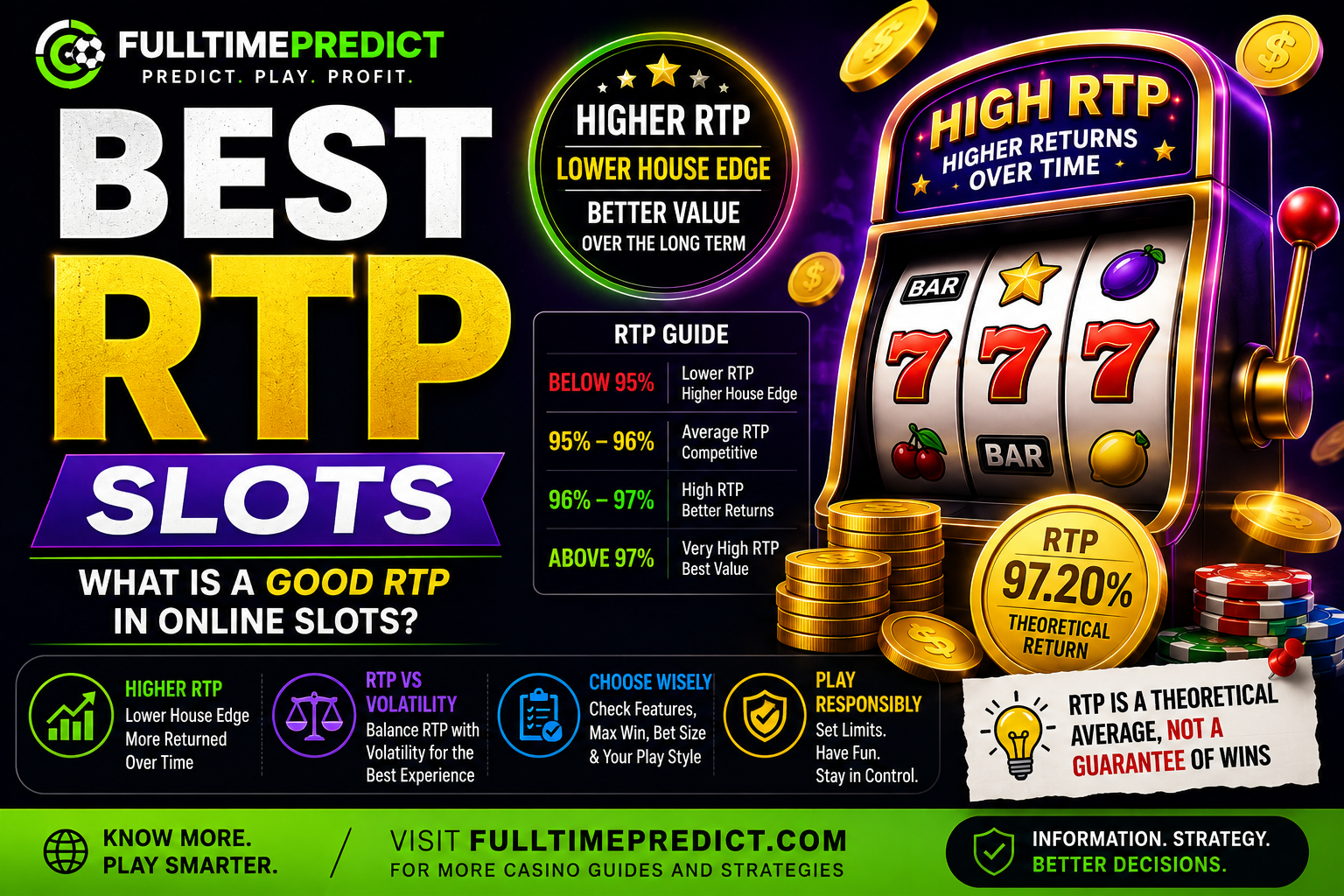
When choosing an online slot, one of the most important numbers to understand is RTP. Players searching for the best RTP slots are usually looking for games with a higher theoretical return percentage over the long term.
However, choosing a slot based on RTP alone can be misleading.
A game may have a high RTP but high volatility, meaning wins can still be less frequent and bankroll swings may be significant. Another slot may have a slightly lower RTP but lower volatility and more frequent smaller wins.
Understanding how these factors work together can help you make more informed choices.
In this guide, FullTimePredict explains what is considered a good RTP for online slots, why high RTP slots attract players, and how RTP should be used alongside volatility and bankroll management.
Important: RTP represents a theoretical long-term average. It does not guarantee that an individual player will win during a particular session.
What Does RTP Mean in Online Slots?
RTP stands for Return to Player.
It is expressed as a percentage and represents the theoretical amount of money a slot machine is designed to return to players over a very large number of spins.
For example, a slot with an RTP of 96% theoretically returns £96 for every £100 wagered across a huge number of spins.
The remaining percentage represents the game’s mathematical house edge.
Example:
| RTP | Theoretical Return | House Edge |
|---|---|---|
| 94% | £94 per £100 wagered | 6% |
| 95% | £95 per £100 wagered | 5% |
| 96% | £96 per £100 wagered | 4% |
| 97% | £97 per £100 wagered | 3% |
| 98% | £98 per £100 wagered | 2% |
These figures are long-term mathematical averages, not predictions for a single session.
A player can win significantly more than expected during a short period, while another player can lose despite playing a high RTP slot.
What Is Considered a Good RTP for a Slot?
There is no single RTP percentage that guarantees a slot is “good,” but many players generally use the following ranges when comparing games.
Low RTP: Below 95%
Slots below 95% RTP generally have a larger theoretical house edge.
This does not mean players cannot win. Short-term outcomes remain random.
However, when comparing similar games over the long term, many players prefer slots with higher RTP percentages.
Average RTP: Around 95% to 96%
This range is commonly considered competitive for online slots.
Many popular online slot games operate somewhere within this area, although RTP can sometimes vary depending on the casino, version of the game or configuration offered.
Good RTP: 96% to 97%
A slot with an RTP of 96% or above is generally considered attractive from a mathematical perspective.
This does not mean the slot will pay during your session. It simply means the game’s theoretical long-term return is higher than that of a comparable lower-RTP game.
Very High RTP: Above 97%
Slots above 97% RTP are particularly interesting to players who focus heavily on theoretical return.
However, a high RTP percentage should always be considered alongside:
- Volatility
- Maximum payout
- Bonus features
- Betting limits
- Game mechanics
- Your available bankroll
The highest RTP is not automatically the best choice for every player.
RTP Percentage Guide: Low vs Average vs High RTP Slots
| RTP Range | General Classification | Suitable For |
|---|---|---|
| Below 95% | Lower RTP | Players focused more on features or entertainment |
| 95%–96% | Average/Competitive RTP | General slot players |
| 96%–97% | High RTP | Players comparing theoretical return |
| Above 97% | Very High RTP | Players strongly focused on mathematical return |
The important point is that RTP is only one part of a slot’s mathematical design.
A high RTP game can still experience long losing streaks.
Why Do Players Look for the Best RTP Slots?
The main reason is simple: over an extremely large number of spins, a higher RTP theoretically means more money is returned to players.
For example, consider two hypothetical slots:
- Slot A: 94% RTP
- Slot B: 97% RTP
Over a very large sample of wagers, Slot B theoretically has a lower house edge.
That does not mean Slot B will win on the next spin.
Online slots use random outcomes, and individual sessions can produce results far above or below the theoretical RTP.
Think of RTP as a long-term mathematical measurement, not a prediction tool.
It cannot tell you:
- When a slot will pay
- When a bonus round will trigger
- Whether your next spin will win
- Whether you will recover previous losses
Anyone claiming that RTP can predict when a slot is “due” to pay is misunderstanding how random slot outcomes work.
Does a Higher RTP Guarantee That You Will Win?
No.
This is one of the most important things players need to understand.
A slot with a 97% RTP does not guarantee that you will receive £97 back after wagering £100.
You could:
- Win more than £100
- Win less than £100
- Lose the entire amount
- Hit a large payout
- Experience a long losing streak
RTP becomes more meaningful only across an extremely large number of spins.
Individual gambling sessions are affected by randomness.
Best RTP Slots: RTP Is Not the Same as Volatility
One of the biggest mistakes players make is confusing RTP with volatility.
These are different measurements.
RTP tells you:
The theoretical percentage of money returned to players over the long term.
Volatility tells you:
How the game’s payouts may be distributed.
For example:
Low Volatility Slots
These may offer:
- More frequent wins
- Smaller average payouts
- Less dramatic bankroll swings
High Volatility Slots
These may offer:
- Less frequent wins
- Larger potential payouts
- Bigger bankroll swings
- Longer losing periods
A slot can have:
High RTP + High Volatility
or:
High RTP + Low Volatility
This is why RTP alone does not tell the complete story.
For a detailed explanation, readers can also explore our Slot Volatility Explained: High vs Low Volatility Slots guide.
Which Is More Important: RTP or Volatility?
Neither is automatically more important.
The answer depends on what type of experience you prefer.
Choose RTP Carefully If You Focus On:
- Long-term mathematical value
- Comparing house edges
- Understanding slot mechanics
- Making informed game selections
Consider Volatility If You Focus On:
- Win frequency
- Bankroll swings
- Payout potential
- Playing style
The best approach is to consider both.
Example:
A player with a smaller entertainment budget may prefer a game with moderate or lower volatility.
A player who accepts larger swings and understands the increased risk may prefer higher volatility.
Neither strategy guarantees a profit.
How to Choose the Best RTP Slot for Your Playing Style
Instead of simply choosing the game with the highest RTP number, consider the following factors.
1. Check the RTP Percentage
Look for the game’s published RTP information where available.
Be aware that some slot games may be offered with different RTP configurations.
The version available at one casino may not always have exactly the same theoretical RTP as another version of the game.
Always check the information provided for the specific game you are playing.
2. Check the Volatility
Ask yourself:
Can my bankroll comfortably handle losing streaks?
High-volatility slots may produce bigger swings.
If you are playing for entertainment and prefer a potentially steadier experience, lower or medium volatility may be more suitable.
3. Understand the Maximum Payout
Maximum payout refers to the largest potential win available under the game’s rules.
However, a large maximum win should not be interpreted as a likely outcome.
Extremely large payouts can be rare.
4. Check the Game Features
RTP is important, but the game should also offer features you understand and enjoy.
These may include:
- Free spins
- Multipliers
- Bonus rounds
- Cascading reels
- Expanding symbols
- Wild symbols
- Scatter symbols
A higher RTP does not automatically make a game more entertaining.
5. Consider Your Bankroll
Your bankroll should influence your choice of game and stake size.
Avoid increasing bets simply because a slot has a high RTP.
A high RTP does not reduce the possibility of losing your bankroll during a short session.
Set a budget before playing and avoid chasing losses.
Common Mistakes Players Make When Looking for High RTP Slots
Mistake 1: Assuming High RTP Means Guaranteed Profit
RTP is not a promise of profit.
It is a theoretical long-term calculation.
Mistake 2: Ignoring Volatility
Two slots can have similar RTP percentages but produce very different playing experiences.
Always consider volatility alongside RTP.
Mistake 3: Believing a Slot Is “Due” to Pay
A previous losing streak does not mean the next spin is more likely to produce a win.
Slot outcomes are designed around random processes.
Mistake 4: Increasing Bets to Recover Losses
Chasing losses can quickly increase risk.
Previous outcomes do not guarantee future results.
A sensible approach is to use a budget and stay within it.
Mistake 5: Assuming Every Version of a Slot Has the Same RTP
Some games can be configured with different RTP settings.
Always check the information available for the specific version offered by the casino.
What Is a Good RTP for Beginners?
For players learning how online slots work, understanding the relationship between RTP and volatility is often more valuable than simply searching for the highest number.
A game in the 96% range or above may attract players looking for a competitive theoretical return, but beginners should also consider:
- How much they can afford to spend
- The volatility of the game
- The minimum and maximum bets
- The game’s features
- Their preferred level of risk
The goal should be entertainment and informed decision-making rather than expecting guaranteed returns.
How RTP and House Edge Are Connected
RTP and house edge are directly related.
The basic relationship is:
House Edge = 100% − RTP
For example:
- A 96% RTP slot has a theoretical 4% house edge.
- A 97% RTP slot has a theoretical 3% house edge.
Again, this describes the mathematics over the long term.
It does not describe what will happen during an individual session.
Are High RTP Slots Better Than Low RTP Slots?
From a purely theoretical mathematical perspective, a higher RTP means a lower house edge.
However, “better” depends on what you are looking for.
A lower RTP slot might still have:
- Features you enjoy more
- Different volatility
- A different jackpot structure
- A larger maximum payout
- More entertaining bonus rounds
The smarter approach is to understand the complete game rather than choosing based on a single number.
How to Compare Online Slots Before Playing
Use this simple checklist:
✓ Check the RTP
Understand the theoretical return percentage.
✓ Check Volatility
Decide whether you are comfortable with the potential swings.
✓ Check the Maximum Win
Remember that maximum payouts are not guaranteed.
✓ Check the Features
Understand free spins, multipliers and bonus mechanics.
✓ Check the Betting Range
Choose stakes that fit your entertainment budget.
✓ Set a Limit
Decide how much you are prepared to spend before you start.
Learn More About Online Slots
What Is Slot RTP? Understand how Return to Player percentages work and why RTP should be considered alongside volatility.
Learn more about Slot Volatility and discover why two slots with the same RTP can produce very different playing experiences.
Best RTP Slots FAQs
What does RTP mean in slots?
RTP means Return to Player. It represents the theoretical percentage of money wagered that a slot is designed to return to players over a very large number of spins.
What is considered a good RTP for an online slot?
Many players consider an RTP of around 96% or higher to be competitive, although the best choice also depends on volatility, features and personal playing preferences.
Is a 97% RTP slot guaranteed to pay more?
No. A 97% RTP is a theoretical long-term average and does not predict the outcome of an individual session.
Are high RTP slots safer?
Not necessarily. A high RTP does not eliminate gambling risk.
High-volatility slots can still produce significant losing streaks even when their RTP is relatively high.
Is RTP more important than volatility?
Both are important.
RTP describes theoretical long-term return, while volatility helps describe how wins and losses may be distributed.
Can I predict when a slot will pay?
No. RTP cannot be used to predict when a particular slot will produce a winning spin or bonus round.
Can a slot have high RTP and high volatility?
Yes. These are separate characteristics. A slot can offer a relatively high theoretical RTP while still producing infrequent wins and large bankroll swings.
Final Thoughts: How to Find the Best RTP Slots
The best RTP slots are not necessarily the games with the single highest percentage.
A smart player considers the complete picture.
RTP helps you understand the game’s long-term mathematical return, while volatility helps you understand the potential pattern and size of bankroll swings.
Before choosing an online slot, consider:
- RTP
- Volatility
- Game features
- Maximum payout
- Betting limits
- Your entertainment budget
The most important thing to remember is that RTP does not guarantee a winning session. Online slot outcomes remain unpredictable, and gambling should always be approached responsibly.
For more guides, explore FullTimePredict’s casino and slot content to better understand RTP, volatility, online slot mechanics and responsible bankroll management.

Comments are closed.