

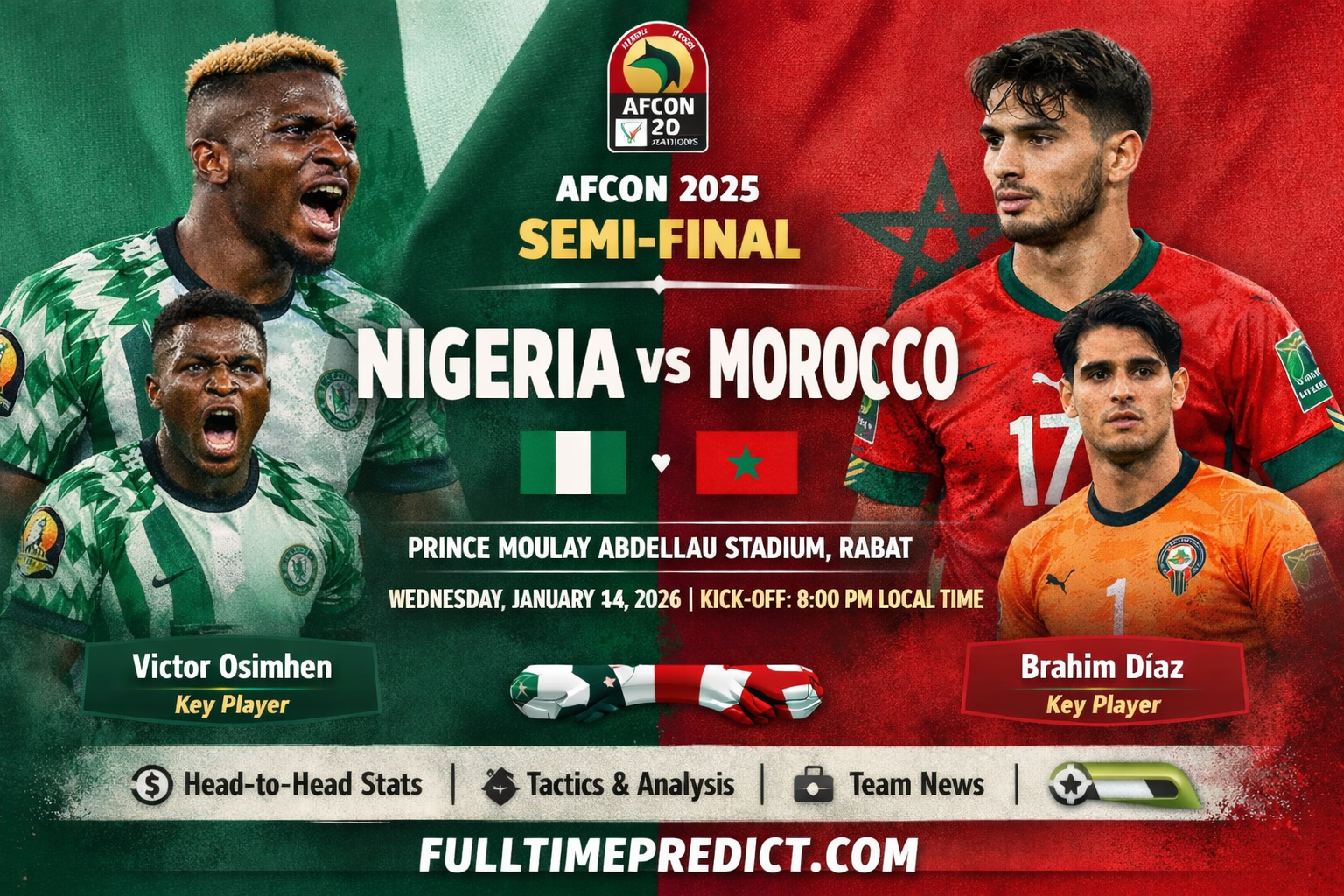
The stage is set for one of the most anticipated encounters of the Africa Cup of Nations (AFCON) 2025/2026: Nigeria vs Morocco in the semi-finals. This match — scheduled at the iconic Prince Moulay Abdellah Stadium in Rabat, Morocco — brings together two of Africa’s most successful football nations with contrasting ambitions and stories in the tournament.
Nigeria — the Super Eagles — are chasing a historic fourth AFCON title and a record-equalling ninth final appearance. Morocco — the Atlas Lions and hosts — are seeking their first continental crown since 1976 and a home final in front of fervent supporters.
This article explores everything from team form and tactical analysis to head-to-head history, player impact, psychological factors, and what’s truly at stake — presented in a way that aligns with Google’s latest EEAT guidelines.
Tournament Context: Unbeaten Runs and Momentum
Nigeria’s Unstoppable Attack
Nigeria arrive at the semi-final unbeaten, winning all five matches in AFCON 2025/2026 — an achievement that sees them with 14 goals scored, the highest tally of any team at this stage. Their consistent attacking output — including scoring 2+ goals in every match — underscores their dynamic forward play and ruthless efficiency in front of goal.
Led by Victor Osimhen, Nigeria’s offense is not merely potent — it’s disciplined and data-driven. Osimhen alone has tallied multiple goals and key contributions throughout the tournament, and Nigeria have never lost an AFCON match in which he has scored or assisted.
Their shot-conversion rate — currently among the best in the competition — speaks to both precision and collective coordination.
Morocco’s Defensive Prowess & Tactical Discipline
Morocco, too, enter the semi-final unbeaten. Their journey has been marked by a rock-solid defense, with four clean sheets, the most by any side in the tournament. Goalkeeper Yassine Bounou has been central to this defensive strength, becoming the first Moroccan keeper to record four AFCON clean sheets.
Offensively, Morocco combine individual brilliance with structured set-pieces. Brahim Díaz, their standout attacker, has scored in five consecutive matches, narrowly missing a national AFCON scoring record.
This balance — tactical defense with opportunistic attack — makes them a formidable challenge for any opponent.
Head-to-Head History & Psychological Edge
Historical Record
Nigeria and Morocco have met 11 times before in all competitions. Morocco hold the edge with six wins, Nigeria have three, and there have been two draws.
In AFCON competition specifically, Morocco have won 3 of the 5 previous meetings, with Nigeria taking 2. Interestingly, all five AFCON encounters produced outright results — no draws — underscoring the competitive intensity of this matchup.
Important historical notes include:
-
1980 AFCON semi-final — Nigeria defeated Morocco 1-0 en route to their first title.
-
2000 and 2004 matches — Nigeria and Morocco traded wins and losses, reflecting the fluctuating dominance between the two sides.
Nigeria vs Host Nation Trends
Nigeria’s performances against host nations at AFCON knockout stages have historically been mixed. Prior to this match, they have faced hosts in five knockout ties — including semi-finals — but have won only once in open play.
That “host factor” — especially playing in a vibrant Rabat — introduces both tactical pressure and psychological intensity that could influence the match’s ebb and flow.
Tactical Breakdown: Style, Strategy & Key Matchups
Nigeria: Fast, Direct, High Press
Under coach Eric Chelle, Nigeria’s approach has emphasized:
-
Direct attacking transitions
-
High pressing to recover the ball quickly
-
Sharp interplay in the final third
This has allowed players like Victor Osimhen, Akor Adams, Ademola Lookman, and Alex Iwobi to impact games beyond traditional goal scoring. Their roles extend into chance creation, assists, and playmaking.
Defensively, Nigeria’s balance between aggression and positional discipline has reduced opposition chances, allowing them to maintain continuous offensive support without sacrificing coverage behind the ball.
Morocco: Tactical Structure and Set-Piece Dominance
Coach Walid Regragui has optimized Morocco’s tactical identity:
-
Organized defensive lines
-
Compact midfield support
-
Effective use of set-pieces
Morocco’s scoring record — including multiple goals from set plays — highlights a team that maximizes scoring opportunities via strategic approaches rather than sheer chance.
Furthermore, midfield distribution and ball retention statistics reflect Morocco’s intent to control tempo, especially against dynamic forwards like Osimhen.
Player Focus: Heroes & Match Influencers
Victor Osimhen (Nigeria)
-
4+ goals in AFCON 2025/2026
-
Leader in goal contributions for Nigeria
-
Key figure in Nigeria’s offensive rhythm
Osimhen’s presence shifts opponent defensive focus, creating space for teammates and influencing aerial and ground duels alike.
Brahim Díaz (Morocco)
-
5 goals in the tournament
-
Near national scoring record at AFCON
-
Provides clinical finishing and consistent pressure
His attacking creativity and finishing prowess add a vital dimension to Morocco’s progression.
Yassine Bounou (Morocco, Goalkeeper)
With four clean sheets, Bounou’s experience under pressure has been a key factor in Morocco’s defensive stability.
The Venue & Home Advantage
Playing at the Prince Moulay Abdellah Stadium in Rabat, Morocco draws enormous crowd support and familiarity with pitch conditions — factors that often influence match rhythm and momentum in international football.
The dynamic fan environment can serve as both inspiration for hosts and a psychological hurdle for visitors. Experts emphasize that crowd influence — particularly in latter tournament stages — impacts referee perception, team confidence, and game tempo. Analyses of past AFCON host performances support this insight.
What’s at Stake? Stakes Beyond the Pitch
Nigeria’s Ambition
For Nigeria, a win would mean:
-
A fourth AFCON title
-
Back-to-back final appearances
-
Matching Ghana’s record of nine finals
These achievements would further solidify Nigeria’s legacy as one of Africa’s giants.
Morocco’s Dream
For Morocco:
-
First AFCON title in nearly 50 years
-
Hosting glory with home fans
-
Establishing national football momentum ahead of global competitions
This desire to write new history adds emotional weight to the encounter.
Statistical Edge & Analytical Predictions
A data-driven look reveals:
-
Nigeria’s scoring consistency
-
Morocco’s clean sheet record
-
Close head-to-head balance
-
Tactical contrasts likely to define match flow
These numbers suggest a closely contested game, where margins such as set pieces, goalkeeper saves, and strategic substitutions could decide the outcome.
Injuries, Lineup Considerations & Tactical Adjustments
Detailed injury and lineup reports will continually evolve — but both teams have depth across key positions. Head coaches must balance:
-
Player fatigue
-
Match tempo control
-
Tactical flexibility against opponent strengths
Final Thoughts: Prediction & Expert Insight
While football remains unpredictable, the data suggests:
-
A tightly contested match
-
Tactical battles in midfield and defense
-
Key moments defined by decision-making under pressure
Fans and analysts alike expect a thrilling showdown, where historical context, player brilliance, and tactical nuance collide.
Conclusion
The Nigeria vs Morocco AFCON 2025/2026 semi-final stands as a definitive moment in African football — far beyond a single match. It is a convergence of history, ambition, strategy, and national pride. Whether you’re a dedicated supporter or a casual fan, this game encapsulates the spirit of competitive football at its highest continental level.
Stay tuned for kickoff, expert predictions, and post-match analysis as we unpack every facet of this monumental fixture.

Comments are closed.