

Manchester United appointed Michael Carrick as head coach until the end of the 2025/26 season, following the dismissal of Ruben Amorim. The former United midfielder — a club legend with 464 appearances and six major titles during his playing career — returns to the dugout with a mandate to stabilize the side and pursue European qualification during an unpredictable Premier League campaign.
Carrick’s first five matches in charge form one of the toughest openings in recent United managerial history, including clashes with current title contenders and tactical tests that will immediately define his tenure. This article examines the fixtures, tactical expectations, squad challenges, and the context behind Carrick’s appointment — providing a thorough analysis that aligns with Google’s updated content quality guidelines (E‑E‑A‑T: Experience, Expertise, Authoritativeness, Trustworthiness).
1. Context: Carrick’s Appointment as United Head Coach
Manchester United officially appointed Carrick as interim head coach on 13 January 2026, with the club’s leadership praising his knowledge of the squad and leadership credentials. The appointment follows United’s poor run of form, including an FA Cup exit and difficulties in domestic competitions, prompting the board to choose a figure with deep internal experience and credibility with players.
Carrick succeeds Ruben Amorim, whose tenure was marked by internal disagreement and poor results. Interim caretaker Darren Fletcher managed the second‑to‑last match before Carrick, leaving United in seventh place in the Premier League at the time of the transition.
2. The First Five Matches: Schedule & Competitive Context
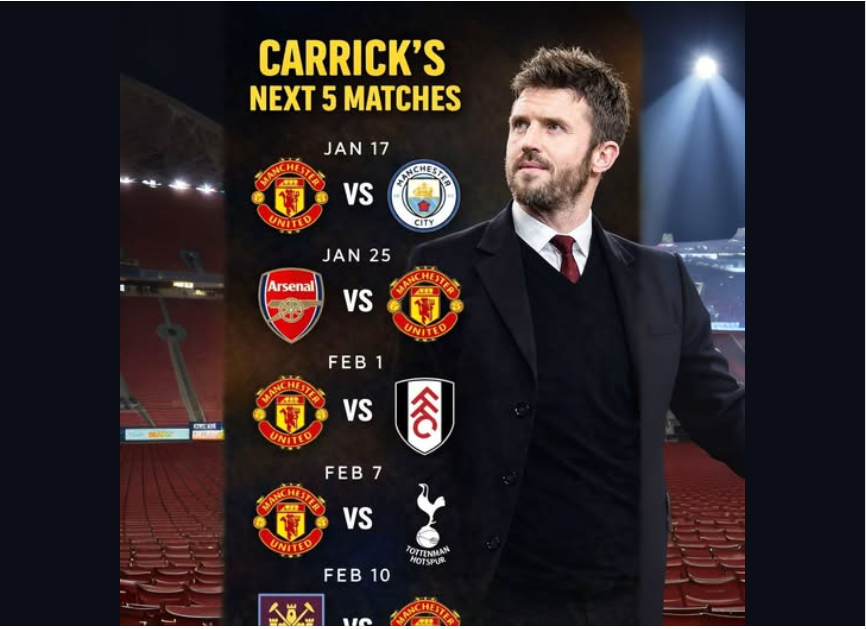
According to the latest confirmed fixtures, Carrick’s first five assignments as Manchester United head coach are:
| Match | Opponent | Competition | Venue |
|---|---|---|---|
| 1 | Manchester United vs Manchester City | Premier League | Old Trafford |
| 2 | Arsenal vs Manchester United | Premier League | Emirates Stadium |
| 3 | Manchester United vs Fulham | Premier League | Old Trafford |
| 4 | Manchester United vs Tottenham Hotspur | Premier League | Old Trafford |
| 5 | West Ham United vs Manchester United | Premier League | London Stadium |
This run includes three of the league’s strongest sides (City, Arsenal, Tottenham) within Carrick’s first four matches — an exceptionally demanding start that will shape his early assessment.
3. Tactical Blueprint: What Carrick Brings to United
3.1. Overall Philosophy
Carrick’s managerial style blends patient build‑up play, structured possession, and positional discipline with a cautious attacking structure. His tactics at Middlesbrough were often described as possession‑heavy and patient, though sometimes criticized for lacking in‑game adaptation.
At United, he is expected to employ a 4‑2‑3‑1 formation with variations depending on opposition strength — encouraging controlled possession from deeper positions while looking to exploit transitions through quick forward combinations.
3.2. Defense & Midfield Structure
United’s defensive unit has struggled with organization and injuries during the season, leading to tactical emphasis on:
-
Compact lines during turnovers
-
Defensive midfield support to shield back four
-
Frequent building from centre‑backs with midfield pivot involvement
These elements are crucial against high‑pressing opponents like City and Arsenal. Carrick’s challenge will be balancing patience with aggression in transition.
3.3. Attacking Identity
Offensively, Carrick values:
-
Circulating possession to create half‑space opportunities
-
Wide players tucking inside for combinations
-
Midfield runners supporting the forward line
His familiarity with United’s elite attackers and midfield playmakers could pay dividends, but converting possession into high‑quality chances will be essential.
4. Match‑by‑Match Tactical Preview & Analysis
Match 1 — Manchester United vs Manchester City
Tactical Challenge:
-
United must balance defensive stability with attacking threat.
-
City’s high press and positional rotations will test United’s transitional play.
-
Carrick must decide whether to crowd the midfield or invite City to chase possession.
Key Tactical Focus:
-
Compact midfield lines to counter City’s overloads
-
Target quick vertical transitions through wide runners
Match 2 — Arsenal vs Manchester United
Tactical Challenge:
-
Arsenal’s blend of possession and forward momentum will test United’s defensive shape.
-
Carrick’s patience in build‑up must be paired with purposeful risk creation.
Key Tactical Focus:
-
Midfield control to disrupt Arsenal’s rhythm
-
Defensive transitions with forward pressure
Match 3 — Manchester United vs Fulham
Tactical Opportunity:
-
A more balanced opponent where United can impose structure.
-
Carrick will look to assert possession and exploit space between Fulham midfield lines.
Key Tactical Focus:
-
Dynamic wing play
-
Central penetration through quick combinations
Match 4 — Manchester United vs Tottenham Hotspur
Tactical Challenge:
-
Spurs’ counter‑attack speed will test United’s organization.
-
Carrick must choose whether to absorb pressure or press high.
Key Tactical Focus:
-
Defensive compactness
-
Quick switches to isolated wide attackers
Match 5 — West Ham United vs Manchester United
Tactical Opportunity:
-
A fixture where United can assert control.
-
Tactical flexibility will be essential to unlocking West Ham’s mid‑block.
Key Tactical Focus:
-
Transition speed and midfield fluidity
5. Challenges & Squad Adaptation
5.1. Defensive Frailties
United’s defensive vulnerabilities include a lack of consistent shape and leadership from the backline, requiring Carrick urgently to stabilize the unit.
5.2. Midfield Dynamics
With key midfielders struggling or injured, Carrick’s midfield pivots must adjust to shared defensive responsibilities and creative linking roles.
5.3. Morale & Leadership
The squad has dealt with managerial instability and poor morale. Carrick’s immediate task is rebuilding confidence and instilling clarity in roles and tactical cohesion.
Historical Context: Interim Managers at Manchester United
-
Carrick follows a line of former United players stepping in as interim managers, including Ole Gunnar Solskjaer and Ryan Giggs
-
Historical pattern shows short-term tactical stability often achieved, but long-term success depends on adaptability
-
Carrick’s deep internal knowledge of players and leadership traits give him an advantage in the first five matches compared to past caretakers
6. Projected Outcomes & What to Watch For
-
Manchester City & Arsenal fixtures will be significant litmus tests.
-
Tactical aggressiveness vs tactical structure balance will be key.
-
United’s ability to convert possession into goals may determine early success under Carrick.
7Internal Links (Suggested)
-
Manchester United Managerial Changes 2025/26
-
Premier League Tactical Strategies Explained
-
How Interim Managers Impact Top‑Flight Teams
FAQs – Michael Carrick First Five Matches at Manchester United
1. Who is Michael Carrick and why is he Manchester United’s head coach?
Michael Carrick is a former Manchester United midfielder and club legend. He was appointed interim head coach in January 2026 following Ruben Amorim’s departure. The board chose Carrick for his leadership, experience with the squad, and tactical knowledge.
2. What are Michael Carrick’s first five matches as United manager?
-
Manchester United vs Manchester City
-
Arsenal vs Manchester United
-
Manchester United vs Fulham
-
Manchester United vs Tottenham Hotspur
-
West Ham United vs Manchester United
These fixtures combine some of the toughest opponents in the league, testing Carrick’s tactical approach immediately.
3. What formation will Carrick likely use?
Carrick is expected to predominantly use 4‑2‑3‑1, switching to 4‑3‑3 if needed, emphasizing structured possession, midfield control, and tactical flexibility.
4. Who are the key players for Carrick in these matches?
-
Bruno Fernandes (creative hub)
-
Amad (primary forward threat)
-
Casemiro & Cuhna (midfield stability)
-
Luke Shaw & Diogo Dalot (wide support and defensive balance)
5. How will Carrick handle defensive challenges?
Carrick is likely to use a double pivot midfield to shield the back four, focus on compact lines during transitions, and instruct selective pressing against high-pressing teams like City and Arsenal.
6. Can Carrick lead United to top-four or European qualification?
Success depends on squad adaptation, injury management, and tactical effectiveness against top sides. With consistent results, Carrick could secure European qualification despite the challenging opening fixtures.
7. Has Carrick managed before?
Yes. Carrick previously coached at Middlesbrough, served as United caretaker manager, and worked extensively as an assistant under previous United managers.
8. What is the main tactical challenge in the first five matches?
Balancing possession control, counter-attacking efficiency, and defensive stability against three top-six teams (City, Arsenal, Spurs) while integrating rotation and maintaining player confidence.
People Also Ask (PAA) Answers
Q1: Who is Michael Carrick managing first in the Premier League?
A: His first Premier League match as Manchester United head coach is against Manchester City at Old Trafford.
Q2: What is Carrick’s preferred formation?
A: Carrick is expected to use a 4‑2‑3‑1 formation, adapting to a 4‑3‑3 against specific opponents.
Q3: How many top-six teams does Carrick face in his first five matches?
A: Three — Manchester City, Arsenal, and Tottenham Hotspur, making it a very challenging opening.
Q4: Who are the key players Carrick will rely on?
A: Bruno Fernandes, Amad, Casemiro, Mbemuo, and Cuhna are likely central to his strategy.
Q5: Has Carrick previously managed Manchester United?
A: He served as a caretaker manager briefly in the past and has extensive experience as an assistant coach.
Conclusion
Michael Carrick’s first five matches at Manchester United represent a critical test of his tactical acumen, leadership, and squad management. Facing three of the Premier League’s top-six teams within this short period, Carrick must balance possession control, defensive solidity, and effective transitions while rebuilding squad confidence.
His deep knowledge of Manchester United’s culture, players, and tactical frameworks gives him a unique advantage, but success will hinge on strategic rotations, adaptability, and precise execution of game plans.
United fans can expect a calculated, disciplined, and dynamic approach from Carrick in these opening fixtures, signaling whether the interim manager can stabilize the club and push for European qualification, potentially shaping the future of the 2025/26 season and beyond.

Comments are closed.