

Chelsea Football Club — one of England’s most iconic and trophy‑laden clubs — has endured one of the most dramatic managerial periods in recent Premier League history. After a promising yet turbulent tenure under Enzo Maresca, the Blues parted ways with the Italian coach at the start of 2026. Since then, Chelsea have appointed Liam Rosenior as the new head coach on a long‑term contract running into 2032.
This comprehensive article offers:
-
In‑depth managerial updates
-
Tactical analysis of Rosenior’s philosophy
-
The reasons behind Maresca’s exit
-
Squad implications and future outlook
-
FAQs about the managerial transition
1. What Happened With Enzo Maresca?
Enzo Maresca’s tenure at Chelsea was a mix of major success and growing internal tensions:
-
Led Chelsea to UEFA Conference League glory and the FIFA Club World Cup — historic achievements that restored silverware to the club’s cabinet.
-
Despite the trophies, results dipped sharply in late 2025 and the team struggled for consistent Premier League form.
-
Reports of disagreements — especially with medical and backroom staff over player fitness and rotation — emerged in December 2025.
-
Maresca’s exit on 1 January 2026 was confirmed by mutual consent amid a breakdown in communications with the club hierarchy.
Tactical Takeaways From Maresca’s Chelsea:
-
Positional Play: Maresca modelled Chelsea on a dynamic build‑up structure, often using a 4‑3‑3/3‑4‑3 hybrid to promote midfield control.
-
High Pressing Triggers: Chelsea aimed to suffocate opponents immediately upon turnover phases, though this exposed vulnerabilities in transition.
-
Youth Integration: Emphasis was placed on blooding technical young players, but consistency lagged against Premier League top six opponents.
Key Point: Despite strong tournament results, Premier League form remains the primary mandate for Chelsea managers. Maresca’s trophy success was outweighed by a dip in league performance and dressing room friction.
2. Enter Liam Rosenior — Chelsea’s New Head Coach (2026–2032)
Chelsea confirmed the appointment of Liam Rosenior as head coach on 6 January 2026, on a long‑term six‑and‑a‑half‑year deal.
Who Is Rosenior?
-
Age: 41
-
Previous Role: Manager of Strasbourg (Ligue 1), owned by BlueCo — Chelsea’s parent company.
-
Coaching Experience: Managed Strasbourg to a top‑seven Ligue 1 finish and European qualification.
-
Playing Background: Former Premier League and Championship defender.
Rosenior’s Stoke of Tactical Identity
Chelsea’s new coach brings a blend of structure, positional discipline, and modern pressing concepts:
➤ 1. Shape & System
-
Preferred formation: 4‑2‑3‑1 evolving into 4‑3‑3
-
Build‑up play: Encourages short passing from the back with intelligent switches of play
-
Midfield tasked with dual roles — control and quick vertical transitions
➤ 2. Transitional Football
-
Rosenior’s teams focus on controlled transition, ensuring midfield players track runners and protect spaces between lines.
-
Compared to Maresca’s aggressive press, Rosenior balances proactive pressing with positional discipline.
➤ 3. Youth versus Experience Balance
-
Strong belief in development pathways — integrating academy players into first‑team structures.
-
Simultaneously, he’s shown willingness to back experienced figures when tactical balance demands it.
Verdict: Rosenior doesn’t radically dismantle Chelsea’s attacking DNA, but prioritises real‑world pragmatism — something that might help turn league results around.
3. Early Rosenior Milestones & Initial Decisions
Backroom Restructuring
Chelsea announced new backroom appointments under Rosenior:
-
Calum McFarlane retained in senior coaching role
-
Justin Walker, Kalifa Cisse — new first‑team coaches
-
Ben Warner — first‑team analyst
-
Ben Roberts — goalkeeper coach
-
Bernardo Cueva — set‑piece coach retained
These signings suggest Rosenior wants a collaborative, analytic‑driven coaching environment, blending internal continuity with fresh tactical perspectives.
First Competitive Matches
-
Rosenior’s early tenure has seen mixed results, including a League Cup defeat where he publicly accepted responsibility for goalkeeper errors, demonstrating leadership accountability.
-
Under new leadership, key senior players like Raheem Sterling and Axel Disasi are reportedly being reintegrated into first‑team plans.
4. Tactical Expectations & Chelsea’s Style Under Rosenior
Possession Dynamics
Rosenior’s Chelsea isn’t about static possession — tactical intelligence, positional rotations, and tempo shifts from deep are integral.
Players are coached to:
-
Occupy halfspaces
-
Stretch lines laterally for switching play
-
Quick recovery transitions
Defensive Coordination
Chelsea’s defensive structure focuses on:
-
Compact lines when out of possession
-
Midfielder trackbacks
-
Using ball‑wins as triggers for quick vertical counters
This hybrid style is designed for Premier League adaptability — crucial against big‑six rivals.
5. Why the Appointment Matters: Club and Broader Impact
1. Long‑Term Vision
Chelsea’s decision to give Rosenior a contract until 2032 reflects a shift toward long‑term project building rather than short‑term turnover.
2. Representation & Culture
Rosenior’s appointment is significant:
-
He is one of the few Black British head coaches in the Premier League — a milestone for diversity in top‑tier football.
3. Hierarchy & Stability
Chelsea have endured frequent managerial changes since BlueCo ownership began. Stabilising under one philosophy could be pivotal for future success.
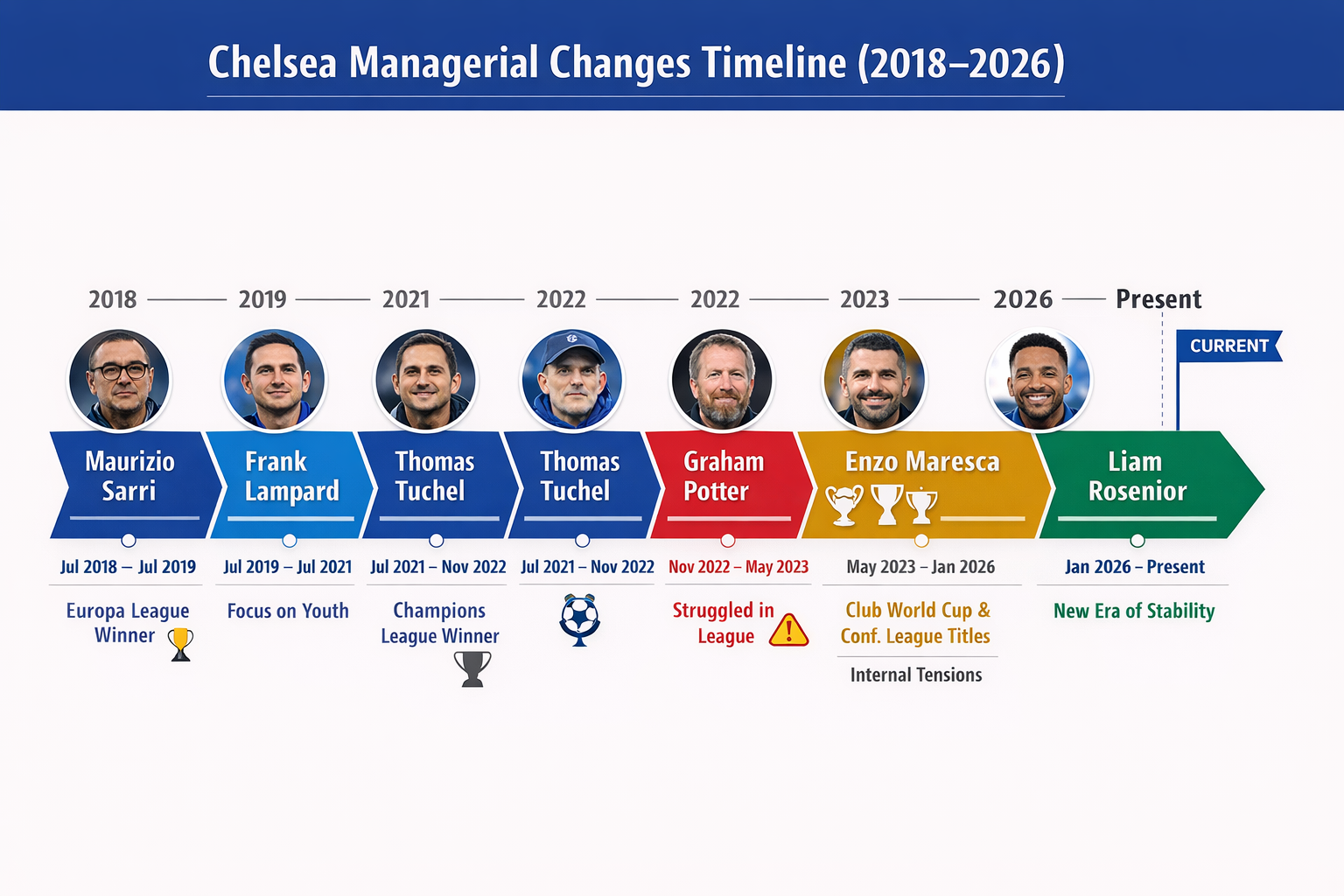
Chelsea Managerial Changes Timeline (2018–2026)
Format: Horizontal timeline with years on top, managers’ names, tenure periods, and key achievements.
Example Data:
| Period | Manager | Key Notes / Achievements |
|---|---|---|
| Jul 2018 – Jul 2019 | Maurizio Sarri | Europa League Winner, style: possession-based 4‑3‑3 |
| Jul 2019 – Jul 2021 | Frank Lampard | Focus on youth, top-4 finishes, Chelsea’s first homegrown project |
| Jul 2021 – Nov 2022 | Thomas Tuchel | Champions League Winner, tactical flexibility, strong defence |
| Nov 2022 – May 2023 | Graham Potter | Short tenure, inconsistent league results |
| May 2023 – Jan 2026 | Enzo Maresca | FIFA Club World Cup + UEFA Conference League wins, league struggles, exit due to internal tensions |
| Jan 2026 – Present | Liam Rosenior | Long-term vision, tactical pragmatism, focus on stability |
6. Inside Chelsea’s Leadership Dynamics (Maresca → Rosenior)
Clubs are complex ecosystems. At Chelsea, the evolving interaction between head coach, sporting directors, and ownership has been under scrutiny.
-
Multiple reports suggested tensions between Maresca and medical/technical teams over training loads and fitness concerns.
-
Conversely, Rosenior’s internal familiarity (through Strasbourg partnership) may lead to smoother buy‑in from all departments.
This alignment often defines whether a coach succeeds or struggles — agency, communication, and shared vision are non‑negotiable in elite environments.
7. Chelsea’s Road Ahead — What to Expect
Short Term:
-
League performance improvements
-
More tactical flexibility
-
Rebuilding team confidence
Mid Term:
-
Competing for European qualification
-
Integrating youth with experience
Long Term:
-
Developing a recognisable tactical identity
-
Structured footballing progression from academy to first team
People Also Ask (PAA) + Answers
1. Who is Chelsea’s new coach after Enzo Maresca?
Chelsea appointed Liam Rosenior as head coach in January 2026, on a long-term deal until 2032, following Maresca’s departure due to league struggles and internal tensions.
2. Why did Enzo Maresca leave Chelsea?
Maresca left by mutual consent despite winning the Club World Cup and UEFA Conference League, mainly due to disagreements with backroom staff and inconsistent league performance.
3. What tactical system will Rosenior use at Chelsea?
Rosenior prefers a 4‑2‑3‑1 / 4‑3‑3 hybrid, balancing controlled possession, structured pressing, and quick transitions. Youth development is also a key part of his tactical plan.
4. How will Rosenior’s style differ from Maresca’s?
Unlike Maresca’s aggressive high press, Rosenior emphasizes positional discipline, measured pressing, and balanced transitions, prioritizing long-term stability over short-term risk.
5. Who were Chelsea managers before Enzo Maresca?
Since 2018: Maurizio Sarri, Frank Lampard, Thomas Tuchel, and Graham Potter — each with mixed results and trophy records, leading to Maresca’s appointment.
6. Will Chelsea compete for trophies under Rosenior?
Yes, Rosenior aims to maintain Chelsea’s attacking identity while improving league consistency. Early indicators suggest focus on European qualification and domestic cup runs.
7. How are players reacting to the new coach?
Reports indicate renewed motivation and tactical clarity, with key senior players like Raheem Sterling and Axel Disasi being reintegrated into first-team plans.
8. Is Rosenior considered a long-term solution for Chelsea?
Yes, his contract until 2032 reflects Chelsea’s strategy for stability, continuity, and developing a long-term tactical identity.
Internal Resources You Should Read Next
-
Chelsea Squad Analysis 2025/26: Strengths & Weaknesses
-
How New Managers Impact Premier League Clubs — Case Studies
-
Tactical Evolution of the Modern Manager (2020–26)
Conclusion
Chelsea’s managerial landscape has once again entered a transformative phase. After Enzo Maresca’s departure — despite his historic trophy wins — the club has placed its long-term faith in Liam Rosenior, a coach known for tactical discipline, youth development, and structured transitions.
Rosenior inherits a squad rich in talent but requiring stability, consistency, and a clear tactical identity. His appointment signals Chelsea’s shift toward long-term planning over short-term fixes, with a focus on league performance, European qualification, and sustainable success.
Fans can expect a blend of measured possession, positional discipline, and pragmatic pressing, which differentiates Rosenior from his predecessor while respecting Chelsea’s attacking heritage. As the season unfolds, Rosenior’s ability to integrate youth, manage senior stars, and navigate the Premier League’s challenges will define the club’s trajectory.
In short, Chelsea’s future under Rosenior promises strategic continuity, tactical clarity, and a renewed vision for Stamford Bridge, marking the beginning of a new era for the Blues.
Chelsea Coach Update — FAQs
1. Why was Enzo Maresca relieved of his responsibilities?
👉 While Maresca won significant titles, Chelsea’s league form dipped and internal disagreements over tactical and fitness approaches led to a mutual separation.
2. Who is Chelsea’s new head coach?
👉 Liam Rosenior — appointed on a long‑term deal extending to 2032.
3. What tactical system will Rosenior use?
👉 A flexible 4‑2‑3‑1 / 4‑3‑3 hybrid, with emphasis on structural organisation and controlled transitions.
4. Is Rosenior experienced enough for Chelsea?
👉 He has limited Premier League experience but notable success in France and strong coaching credentials make him a bold appointment.
5. Will Chelsea go back to a more defensive style?
👉 Chelsea will maintain attacking principles but with greater emphasis on strategic balance and transitional fluidity.
6. What’s next for Maresca?
👉 Maresca’s future remains open, with rumours he may pursue top European roles. (No official confirmation yet)
7. How have players reacted to Rosenior’s arrival?
👉 Early signs are positive, with reports of renewed motivation and tactical clarity.
8. Could Chelsea change managers again soon?
👉 Stability is now a priority, but results will ultimately dictate the club’s decisions.

Comments are closed.