

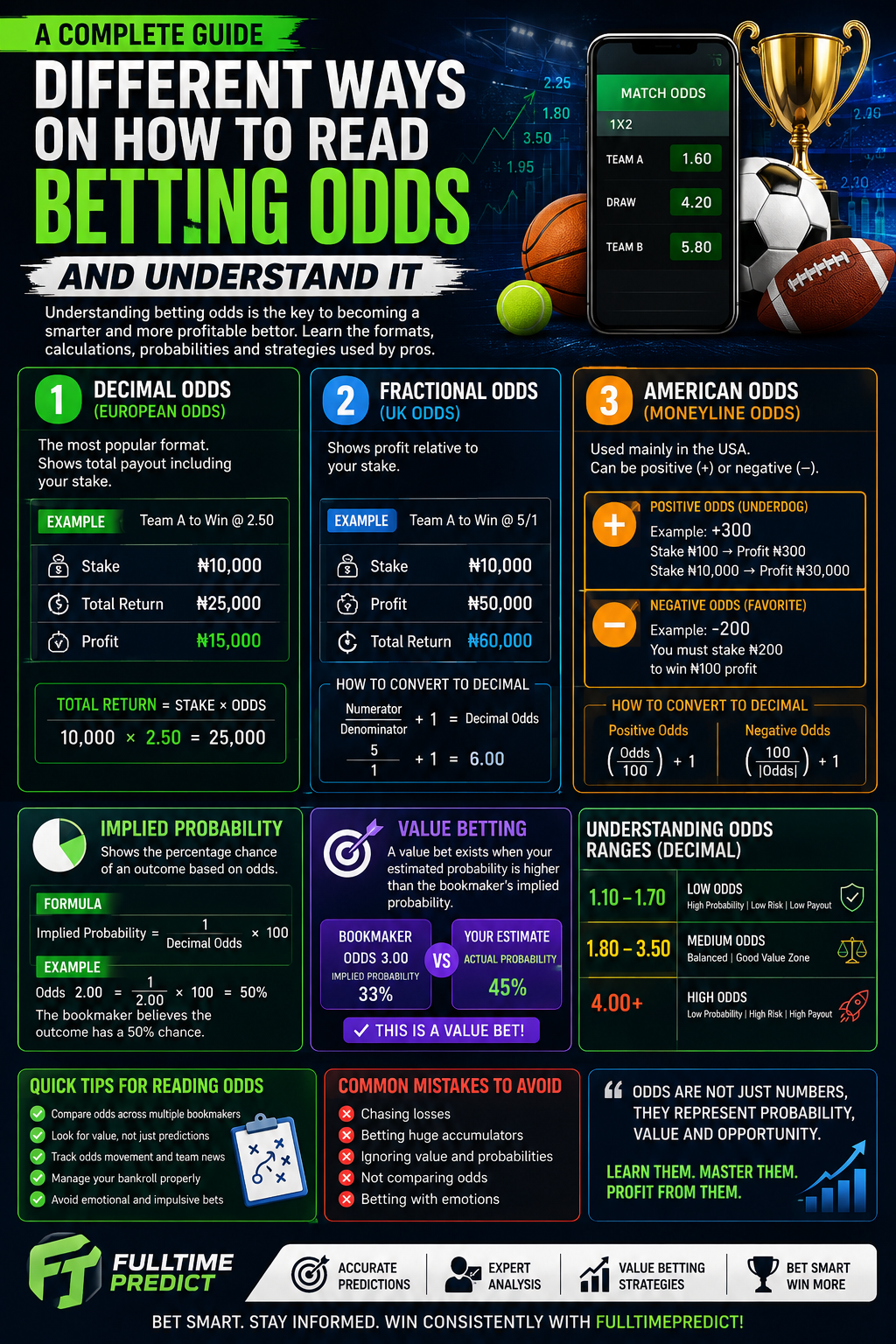
Betting odds are the foundation of sports betting. Whether you are betting on football, basketball, tennis, MMA, or virtual sports, understanding odds is the first skill every bettor must master. Odds determine how much money you can win, the probability of an event happening, and how bookmakers calculate their profit margins.
Many beginners struggle because betting sites display odds in different formats such as decimal odds, fractional odds, and American odds. Without understanding these systems, bettors often make poor decisions, misunderstand payouts, and lose money unnecessarily.
In this complete guide by FulltimePredict, you will learn:
- What betting odds mean
- Different types of betting odds
- How to calculate winnings
- How bookmakers create odds
- How to identify value bets
- Common mistakes beginners make
- Professional tips for reading odds correctly
- Advanced strategies smart bettors use
By the end of this guide, you will fully understand how to read betting odds confidently like an experienced bettor.
What Are Betting Odds?
Betting odds are numbers set by bookmakers that represent:
- The probability of an event happening
- The amount of money you can win
For example:
- Manchester City to win — 1.50
- Draw — 4.20
- Arsenal to win — 6.00
This means bookmakers believe Manchester City has the highest chance of winning because their odds are lower.
Lower odds = higher probability
Higher odds = lower probability
Odds also show your potential payout.
If you bet ₦10,000 on odds of 2.00:
- Total return = ₦20,000
- Profit = ₦10,000
Understanding this simple concept is the key to becoming profitable in sports betting.
Why Understanding Betting Odds Is Important
Most losing bettors focus only on predictions. Smart bettors focus on VALUE.
Understanding odds helps you:
- Identify profitable bets
- Avoid bookmaker traps
- Calculate risk vs reward
- Compare bookmaker prices
- Spot value betting opportunities
- Manage bankroll properly
- Understand implied probability
Professional bettors spend more time analyzing odds movement than actual team names.
The 3 Main Types of Betting Odds
There are three major betting odds formats used worldwide:
- Decimal Odds
- Fractional Odds
- American Odds
Let’s break each one down carefully.
1. Decimal Odds (European Odds)
Decimal odds are the most common odds format globally and are widely used in Nigeria, Europe, Canada, and Australia.
They are the easiest for beginners to understand.
Example:
- Chelsea to win — 2.50
This means your total payout is multiplied by your stake.
Formula
Total Return = Stake × Odds
Example Calculation
Stake = ₦5,000
Odds = 2.50
Total Return:
₦5,000 × 2.50 = ₦12,500
Profit:
₦12,500 − ₦5,000 = ₦7,500
How to Read Decimal Odds
Low Odds (1.10 – 1.70)
These outcomes are considered highly likely.
Examples:
- Strong favorites
- Heavy favorites at home
- Elite teams vs weak teams
Risk:
Low payout
Medium Odds (1.80 – 3.50)
These markets are more balanced.
Examples:
- Competitive matches
- BTTS markets
- Over/Under goals
These are often the best value zones for professional bettors.
High Odds (4.00+)
These represent underdogs or unlikely outcomes.
Examples:
- Correct score bets
- Huge upsets
- Long-shot accumulators
Risk:
Higher probability of losing.
Decimal Odds Implied Probability
Bookmakers use odds to represent probability.
Formula:
Implied Probability=1Decimal Odds×100\text{Implied Probability} = \frac{1}{\text{Decimal Odds}} \times 100
Example:
Odds = 2.00
Probability:
50%
Meaning the bookmaker believes the event has a 50% chance of happening.
Another example:
Odds = 1.50
Probability:
66.7%
2. Fractional Odds (UK Odds)
Fractional odds are popular in the United Kingdom and horse racing markets.
Examples:
- 5/1
- 2/1
- 10/3
- 1/2
These odds show profit relative to your stake.
How Fractional Odds Work
Example:
5/1 means:
For every ₦1 you stake, you win ₦5 profit.
If you stake ₦10,000:
Profit = ₦50,000
Total Return = ₦60,000
Common Fractional Odds Explained
| Fractional Odds | Meaning |
|---|---|
| 1/1 | Even money |
| 2/1 | Double your stake |
| 5/1 | Win 5x your stake |
| 1/2 | Win half your stake |
| 10/1 | Huge underdog |
Converting Fractional Odds to Decimal
Formula:
Decimal Odds=NumeratorDenominator+1\text{Decimal Odds} = \frac{\text{Numerator}}{\text{Denominator}} + 1
Example:
5/1:
5 ÷ 1 + 1 = 6.00
3. American Odds (Moneyline Odds)
American odds are mostly used in the United States.
They appear as:
- Positive (+200)
- Negative (-150)
Many beginners find this confusing, but it becomes simple once explained.
Positive American Odds (+)
Positive odds show how much profit you make from a ₦100 equivalent stake.
Example:
+300
Means:
Stake ₦100 → Profit ₦300
Stake ₦10,000 → Profit ₦30,000
These odds usually represent underdogs.
Negative American Odds (-)
Negative odds show how much you must stake to win ₦100 equivalent profit.
Example:
-200
Means:
You must stake ₦200 to win ₦100 profit.
This represents favorites.
Converting American Odds to Decimal
Positive Odds Formula:
Decimal Odds=(American Odds100)+1\text{Decimal Odds} = \left(\frac{\text{American Odds}}{100}\right)+1
Negative Odds Formula:
Decimal Odds=(100∣American Odds∣)+1\text{Decimal Odds} = \left(\frac{100}{|\text{American Odds}|}\right)+1
How Bookmakers Set Odds
Bookmakers use several factors:
- Team strength
- Injuries
- Form
- Head-to-head records
- Public betting patterns
- Market demand
- Statistical models
They also add a margin called the “vig” or “overround” to guarantee profit.
What Is Implied Probability?
Implied probability converts odds into percentages.
This helps bettors determine whether a bet has value.
Example:
Odds = 4.00
Probability:
25%
If you believe the team has a 40% chance of winning, then the odds may offer value.
This is how professional bettors think.
Understanding Value Betting
Value betting is the secret behind long-term profitable betting.
A value bet occurs when:
Your estimated probability > bookmaker implied probability
Example:
Bookmaker odds: 3.00
Implied probability: 33%
You believe actual probability is 45%.
That is a value bet.
Even if it loses sometimes, over time you profit.
Different Ways to Read Betting Markets
Understanding odds also means understanding market types.
1X2 Betting Odds
This is the most popular football betting market.
- 1 = Home win
- X = Draw
- 2 = Away win
Example:
- Liverpool — 1.70
- Draw — 3.80
- Chelsea — 5.20
Liverpool are favorites.
Over/Under Odds
This market predicts total goals.
Examples:
- Over 2.5 Goals — 1.85
- Under 2.5 Goals — 1.95
Lower odds indicate the more likely outcome.
Both Teams To Score (BTTS)
Examples:
- Yes — 1.75
- No — 2.05
Bookmakers believe both teams scoring is more likely.
- Click here to Explore the Best BTTS Teams in Europe and beyond.
Handicap Betting Odds
Handicap betting balances stronger and weaker teams.
Example:
Manchester City -1.5 @ 2.10
City must win by 2 goals.
- Click here to Explore the top 10 football leagues with most over 2.5 goals.
Correct Score Odds
These are high-risk, high-reward bets.
Example:
- 2-1 — 8.50
- 3-0 — 12.00
- 1-1 — 6.00
Higher odds because outcomes are difficult to predict.
Double Chance Odds
Covers two outcomes.
Example:
- Home or Draw
- Away or Draw
- Home or Away
Lower risk, lower reward.
Reading Odds Movement
Odds constantly change before matches.
This is called odds movement.
Example:
- Arsenal opens at 2.20
- Later drops to 1.85
This means heavy betting money entered Arsenal.
Sharp bettors monitor line movement for clues.
Why Odds Change
Odds move because of:
- Injuries
- Team news
- Weather
- Public money
- Sharp bettor action
- Market corrections
Understanding line movement is critical for advanced betting.
Sharp Money vs Public Money
Public Money
Casual bettors usually back:
- Big teams
- Favorites
- Popular clubs
Sharp Money
Professional bettors use:
- Statistics
- Models
- Value analysis
When sharp money enters a market, bookmakers adjust odds quickly.
Common Beginner Mistakes When Reading Odds
1. Thinking Low Odds Are Safe
Odds of 1.20 can still lose.
Many beginners destroy bankrolls chasing “safe odds.”
2. Ignoring Value
Winning bettors care more about value than prediction accuracy.
3. Betting Huge Accumulators
20-game accumulators look attractive but have extremely low probability.
4. Not Comparing Bookmakers
Different bookmakers offer different odds.
Even small differences matter long-term.
5. Chasing Losses
Emotional betting destroys bankrolls.
How Professionals Read Betting Odds
Professional bettors:
- Compare odds across bookmakers
- Look for value discrepancies
- Understand implied probability
- Analyze line movement
- Avoid emotional betting
- Use bankroll management
They treat betting like investing.
How to Calculate Betting Payouts Easily
Decimal Odds Example
Total Return=Stake×Odds\text{Total Return} = \text{Stake} \times \text{Odds}
Stake = ₦20,000
Odds = 1.85
Return = ₦37,000
Profit = ₦17,000
How Accumulator Odds Work
Accumulator odds multiply together.
Example:
- Match 1 — 1.50
- Match 2 — 2.00
- Match 3 — 1.80
Combined odds:
1.50×2.00×1.80=5.401.50 \times 2.00 \times 1.80 = 5.40
₦10,000 stake returns:
₦54,000
Understanding Bookmaker Margin (Overround)
Bookmakers build profit margins into odds.
Example:
True probabilities may total 100%.
Bookmaker probabilities may total:
104%
106%
108%
That extra percentage guarantees bookmaker profit.
Best Tips for Understanding Betting Odds Faster
1. Focus on Decimal Odds First
They are simplest for beginners.
2. Learn Probability Conversion
Understanding implied probability changes everything.
3. Compare Multiple Bookmakers
Always hunt for the best price.
4. Study Closing Line Movement
Closing odds are highly efficient.
5. Avoid Emotional Betting
Never bet because you support a team.
Advanced Odds Concepts
Closing Line Value (CLV)
If you consistently beat the closing odds, you are likely profitable long-term.
Example:
You bet Arsenal at 2.50.
Closing odds become 2.10.
You got better value than the market.
Expected Value (EV)
Professional bettors calculate expected value.
Positive EV bets lead to long-term profit.
Arbitrage Betting
Arbitrage betting involves using different bookmakers to guarantee profit from odds differences.
Requires speed and multiple bookmaker accounts.
Asian Handicap Odds Explained
Asian handicap removes the draw.
Example:
-0.5 means team must win.
+1.5 means team can lose by 1 goal and still win the bet.
This market is popular among professionals.
Live Betting Odds
In-play odds change every second.
Factors affecting live odds:
- Goals
- Red cards
- Possession
- Match momentum
- Time remaining
Live betting offers opportunities but also emotional risk.
How to Spot Fake “Safe Odds”
Many scammers advertise:
- Guaranteed odds
- Fixed matches
- 100% sure bets
No betting market is guaranteed.
Professional bettors focus on probability and value — not fake certainty.
Best Betting Odds Strategies for Beginners
Start Small
Use small stakes while learning.
Track Every Bet
Keep records of:
- Odds
- Stake
- Profit/loss
- Market type
Learn One Market First
Master one market before expanding.
Avoid Emotional Multiples
Focus on quality over quantity.
Use Bankroll Management
Never risk entire bankroll on one game.
How Odds Affect Long-Term Profitability
A bettor winning at:
1.50 odds
Needs extremely high win rate.
A bettor using:
2.20 odds
Can profit with lower win rate.
Understanding this changes betting strategy completely.
Betting Odds Glossary
| Term | Meaning |
|---|---|
| Odds | Probability + payout |
| Stake | Amount wagered |
| Value Bet | Odds higher than real probability |
| Favorite | Team expected to win |
| Underdog | Team less likely to win |
| Vig | Bookmaker commission |
| CLV | Closing Line Value |
| EV | Expected Value |
Final Thoughts
Understanding betting odds is the most important skill in sports betting. Odds are more than numbers — they represent probability, market opinion, bookmaker margins, and betting opportunities.
Beginners often focus only on predictions, but experienced bettors understand that profitable betting comes from reading odds correctly, identifying value, and managing risk wisely.
Whether you use decimal, fractional, or American odds, the key is learning how probability and payouts connect.
The more you study odds movement, implied probability, and bookmaker pricing, the smarter your betting decisions become.
If you truly want long-term betting success, master odds first before chasing huge accumulators or unrealistic “sure odds.”
People Also Ask (PAA)
How do beginners understand betting odds?
Beginners should start with decimal odds because they are the easiest to calculate. Betting odds represent both probability and potential payout.
What do betting odds mean?
Betting odds show how likely an event is to happen and how much profit you can make if your bet wins.
Which betting odds format is easiest?
Decimal odds are considered the easiest because you simply multiply your stake by the odds to calculate returns.
What are good betting odds?
Good betting odds are odds that offer value compared to the actual probability of the event happening.
Why do betting odds change?
Odds change because of injuries, team news, betting volume, weather, and sharp bettor activity.
What is implied probability in betting?
Implied probability converts betting odds into percentage chances of an event occurring.
FAQ
1. What is the difference between decimal and fractional odds?
Decimal odds show total payout including stake, while fractional odds show only profit relative to the stake.
2. Are lower odds safer?
Lower odds indicate higher probability, but no bet is completely safe.
3. Can betting odds predict match results?
Odds reflect bookmaker probability estimates, but they do not guarantee outcomes.
4. What are value bets?
Value bets occur when the bettor believes the real probability is higher than the bookmaker’s implied probability.
5. Why do bookmakers change odds?
Bookmakers adjust odds based on market activity, injuries, public money, and professional betting action.
6. What is the best betting market for beginners?
1X2 and Over/Under goals are usually the easiest betting markets for beginners.
7. How do accumulators increase odds?
Accumulator bets combine multiple selections, multiplying the odds together for bigger payouts.
8. Can you make long-term profit from betting?
Yes, but it requires discipline, bankroll management, value betting, and understanding betting odds deeply.

Comments are closed.